How Canada’s Health System Works: Provincial Plans Explained (2027)
Most newcomers arrive in Canada believing that healthcare is a seamless, national, and entirely free system that begins the moment they step off the plane. The reality is a complex patchwork of provincial plans, distinct waiting periods, and surprising out-of-pocket costs for essential services like prescriptions. This guide demystifies how provincial healthcare operates, explains the coverage gaps you will inevitably face, and provides a realistic roadmap for securing your health card.
The Foundations of Medicare Federal vs Provincial Roles
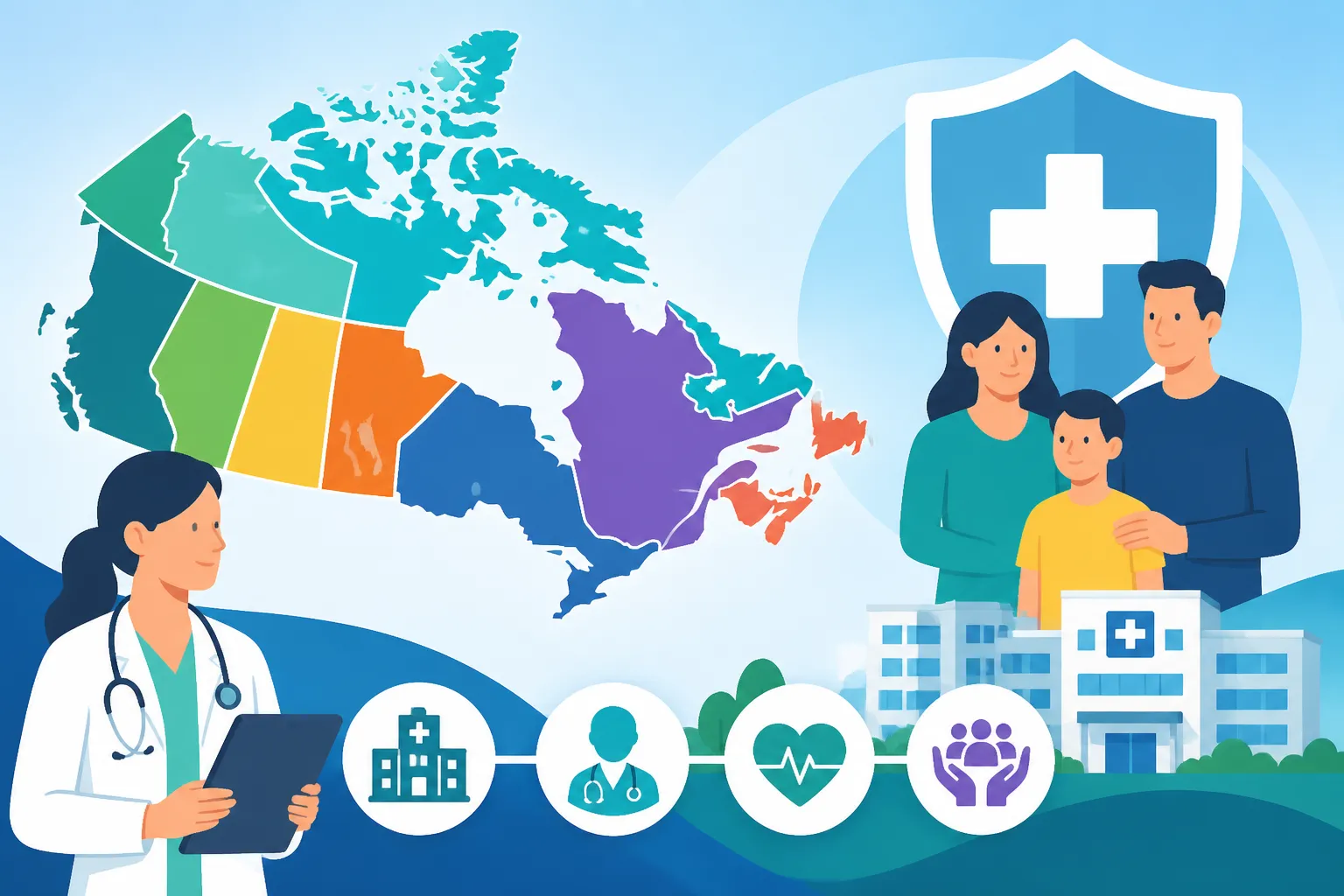
When you first land in Canada, the term "Medicare" is tossed around as if it were a single entity. In truth, Canada’s health system is better described as a collection of thirteen provincial and territorial insurance plans. While the federal government sets national standards through the Canada Health Act, it is the individual province or territory that actually delivers the care. This means that your experience with a doctor in Halifax might be administratively different from someone’s experience in Calgary.
The Canada Health Act mandates that all provincial plans must be publicly administered, comprehensive, universal, portable, and accessible. Public administration ensures that the plans are run by a public authority on a non-profit basis. Universality means that every insured resident of a province is entitled to the same level of care. However, the definition of a "resident" varies from province to province, which is often where the first hurdle for expats appears. If you are on a specific type of work permit or are waiting for your permanent residency, your eligibility might not be immediate.
Portability is one of the most celebrated features of the system, allowing you to receive emergency care in other provinces using your home province's health card. However, this portability has its limits. If you move from Ontario to British Columbia, your Ontario coverage generally only lasts for three months before you must switch to the BC system. During this transition, things can get messy with paperwork, and you might find yourself in a bureaucratic limbo where neither province wants to take responsibility for a non-emergency specialist visit.
Accessibility ensures that insured persons have reasonable access to healthcare facilities without financial or other barriers. This remains a point of contention as wait times for elective surgeries and specialist consultations continue to be a significant frustration for locals and newcomers alike. Understanding that the federal government provides the funding (through the Canada Health Transfer) while the provinces decide how to spend it will help you realize why healthcare is such a heated political topic in every Canadian election.
Understanding the Big Four OHIP MSP RAMQ and AHCIP
Ontario is home to the largest number of newcomers, and its system, the Ontario Health Insurance Plan (OHIP), is often the first one expats encounter. OHIP is strictly a residency-based system. To qualify, you must be physically present in Ontario for at least 153 days in any 12-month period. For many years, there was a mandatory three-month waiting period for new residents, but the province has fluctuated on these requirements based on current public health needs and immigration volumes. You should always check the most recent updates on How to Apply for OHIP in Ontario as a Newcomer.
British Columbia’s Medical Services Plan (MSP) operates a bit differently. Unlike Ontario, BC requires a monthly health fee for certain residents, particularly international students. The application process for MSP is often bundled with the BC Services Card, which serves as both your health insurance card and your photo ID. One of the unique aspects of BC’s system is its heavy integration with digital services, making it one of the more modern provinces to navigate, though the Difference Between OHIP and MSP in Canada remains a common topic of confusion for those moving cross-country.
Quebec’s Régie de l'assurance maladie du Québec (RAMQ) is perhaps the most distinct system in Canada. Quebec has its own rules regarding prescription drug coverage, requiring all residents to be covered by either a private group insurance plan or the public RAMQ drug plan. This is a crucial detail: if your employer does not offer drug benefits, you are legally required to register for the RAMQ drug plan and pay an annual premium through your tax return. This surprise cost often catches newcomers off guard during their first tax season in Montreal.
Alberta Health Care Insurance Plan (AHCIP) is often cited as one of the most accessible for newcomers because, historically, it has not enforced a three-month waiting period for those arriving with valid permanent resident status. If you are moving to Calgary or Edmonton, you should apply for AHCIP immediately upon arrival. You will need to prove your intent to reside in Alberta and provide documentation of your legal status in Canada. For more details, you can look into How to Apply for OHIP, MSP, RAMQ or AHCIP When You Arrive in Canada.
The Newcomer Waiting Period The Critical Coverage Gap
The "three-month wait" is a phrase that strikes fear into the hearts of many expats. In provinces like Ontario and British Columbia, you may not be eligible for provincial coverage for the first 90 days of your residency. I remember landing in Toronto and feeling a strange sense of vulnerability; the thought of a simple slip on the ice resulting in a $3,000 ER bill was enough to keep me indoors. This gap exists because provinces want to ensure you are a committed resident before they begin footing your medical bills.
During this period, you are essentially a "self-pay" patient. If you walk into a clinic without a provincial health card, you will be asked for a credit card upfront. A standard 15-minute consultation with a general practitioner can cost anywhere from $100 to $250, and hospital stays can quickly spiral into the tens of thousands. This is why most immigration consultants and veteran expats emphasize that you must have private insurance. Many people choose SafetyWing for its flexibility, especially if they are unsure of their exact "settling" date or if they plan to travel between provinces during their first few months.
It is a common misconception that your employer-provided health insurance will cover this gap. In Canada, employer-provided "extended health" benefits are designed to supplement provincial plans, not replace them. They usually cover things like dental, massage therapy, and vision, but they assume you already have a provincial health card for the big stuff like hospitalizations and doctor visits. If you rely solely on employer benefits during your first 90 days, you might find that the most expensive part of a medical emergency—the hospital bed and the surgeon—is not covered at all.
There are exceptions to the waiting period. Some provinces have waived these requirements for specific groups, such as those fleeing conflict or certain high-demand healthcare workers. However, for the average skilled worker or family immigrant, the wait remains a reality. It is vital to understand What Happens If I Get Sick During the Health Coverage Waiting Period in Canada so you can plan your finances accordingly. Using a bridge plan like SafetyWing ensures that you aren't gambling with your life savings during your first 90 days in the country.
| Province | Waiting Period | Prescription Coverage | Premium/Fees |
|---|---|---|---|
| Ontario (OHIP) | 0-3 Months (Variable) | Limited (OHIP+) | No |
| British Columbia (MSP) | 3 Months | Fair (PharmaCare) | Yes (Students/International) |
| Alberta (AHCIP) | None (for PRs) | Limited | No |
| Quebec (RAMQ) | 3 Months | Mandatory Drug Plan | Yes (via Taxes) |
| Nova Scotia (MSI) | 3 Months | Limited | No |
What is Covered and the Surprising Gaps
The hallmark of the Canadian system is that you never see a bill for "medically necessary" services provided in a hospital or by a physician. This includes everything from routine check-ups and diagnostic tests to major surgeries and maternity care. If you are pregnant, for instance, you will find that Is Childbirth Free in Canada is largely true, provided you have your provincial health card. The care is high-quality, and the staff are generally excellent, though you may find yourself in a ward room with three other people unless you pay for a private upgrade.
However, the "medically necessary" definition has some massive holes. The biggest gap for most expats is prescription medication. Unless you are in a hospital bed, the government generally does not pay for your pills. If your doctor prescribes antibiotics or maintenance medication for high blood pressure, you take that piece of paper to a pharmacy and pay the full market price. This is where Understanding Prescription Drug Coverage and Pharmacare in Canada becomes essential. Most Canadians rely on private insurance through their employers to cover 70% to 100% of these costs.
Dental and vision care are also excluded from the public system. If you need a root canal or a new pair of glasses, the provincial plan will not help you. This can be a major shock to people coming from countries with robust dental subsidies. While there has been recent movement toward a national dental plan, it is currently targeted at low-income families and seniors. For the average working expat, you will need to budget for these services or ensure your job offer includes a solid benefits package. You can learn more about these costs in Understanding Dental Care Costs and the Canadian Dental Care Plan.
Mental health services are another area where the public-private divide is stark. While you can see a psychiatrist (a medical doctor) for free with a referral, the wait times can be agonizingly long—sometimes six months to a year. If you want to see a psychologist or a licensed therapist, you will usually have to pay out of pocket, with rates often exceeding $200 per hour. Many newcomers find that How to Access Mental Health Services in Canada as a Newcomer involves a mix of community-based non-profits and private insurance to get the support they need.
Navigating Primary Care and the Referral System
In Canada, the family doctor is the gatekeeper to the entire healthcare system. You cannot simply call up a dermatologist or an oncologist and book an appointment; you must be referred by a general practitioner (GP). This is a fundamental part of How Canada's Health System Works: Provincial Plans Explained (2027). The logic is that the GP manages your overall health and ensures that specialists are only seeing patients who truly need their expertise. While this saves the system money, it can be frustrating if you are used to direct access.
The real challenge for newcomers is actually finding a family doctor. Many physicians have full "patient panels" and are not accepting new clients. You might find yourself on a provincial waitlist, like Health Care Connect in Ontario, for several months or even years. In the meantime, you will likely rely on walk-in clinics. These clinics provide non-emergency care on a first-come, first-served basis. While they are convenient for a sinus infection or a prescription refill, they do not provide the continuity of care that a dedicated family doctor offers. You can find tips on this in How to Find and Register with a Family Doctor in Canada.
If you do need a specialist, be prepared for "The Wait." Canada is famous (or perhaps infamous) for its specialist wait times. For non-life-threatening issues, such as a knee replacement or a consultation for chronic migraines, you might wait several months. The system prioritizes based on urgency; if your condition is life-threatening, you will be seen immediately. For everything else, patience is a requirement. Understanding How Specialist Referrals Work in the Canadian Health System will help you manage your expectations and advocate for yourself if your condition worsens.
Emergency rooms (ERs) should only be used for true emergencies. If you show up at an ER with a minor cough, you will likely wait six to ten hours while doctors tend to heart attacks and car accidents. For urgent but non-life-threatening issues—like a deep cut that needs stitches or a high fever—look for "Urgent Care Centres." They are better equipped than walk-in clinics but less overwhelmed than the ER. Also, be aware that Understanding Emergency Numbers (911) and Ambulance Fees in Canada is crucial because, in most provinces, an ambulance ride is not free and can cost several hundred dollars.
Digital Health and Telehealth
By 2026, the Canadian healthcare landscape has shifted significantly toward digital solutions. Every province now has some form of virtual care platform that allows you to speak with a doctor via video or phone. This has been a godsend for those who haven't yet found a family doctor. Platforms like Rocket Doctor or Maple (which may have provincial integrations) allow you to get a diagnosis and a prescription from your living room. In many cases, these virtual visits are covered by your provincial health card.
Digital health also means better access to your own data. Most provinces now offer an online portal where you can view your lab results, immunization records, and even notes from your hospital visits. For instance, in Ontario, the MyHealth portal is becoming the standard way to track your medical history. This is incredibly helpful for newcomers who may need to show proof of vaccination for school enrollment or employment. You can read more about this in Understanding Telehealth and Virtual Care Options in Canada.
However, the rise of "private-pay" telehealth is a controversial trend. Some platforms offer faster access to specialists if you are willing to pay a fee. While the core medical service is often covered by the province, the "convenience fee" for the platform itself is not. This has created a bit of a two-tier system for primary care advice. If you find yourself frequently traveling outside your home province for work or leisure, having a global-friendly plan like SafetyWing can provide an extra layer of digital support and coordination that the provincial plans simply aren't built to handle.
One thing to remember is that while the tech is improving, the underlying system is still provincial. Your digital health record in Alberta might not talk to the system in Nova Scotia. If you move, you should still request a physical copy or a digital download of your records to take with you. For a deeper dive into managing your medical journey, check out Navigating the Canadian Healthcare System: A Newcomer's Roadmap (2027). Keeping your own records is the best way to ensure nothing gets lost in the "provincial silos."
Costs for Non Residents and Tourists
If you are in Canada as a tourist, on a Super Visa, or while your initial work permit is being processed, you are effectively a "non-resident" for healthcare purposes. This means you have zero access to the public system. If you end up in a Canadian hospital, you will be billed at the "International Patient" rate, which is significantly higher than what the government pays for residents. A simple night in a standard hospital bed can cost $3,000 to $5,000, excluding the costs of doctors, medications, and diagnostics.
For those on a Super Visa (parents and grandparents), the Canadian government actually requires you to prove you have at least $100,000 in medical insurance from a Canadian provider. This is because the cost of care for seniors is high, and the government does not want the public system to be burdened by non-residents. Even if you aren't on a Super Visa, traveling without insurance in Canada is a massive financial risk. For short-term stays or those in-between status, SafetyWing offers a practical solution that meets the basic needs of travelers and expats without the eye-watering premiums of some local providers.
Many people ask, Can Tourists Access Emergency Care in Canada? The answer is yes—hospitals will never turn you away in a life-or-death situation. However, they will expect payment or proof of insurance. If you cannot provide either, you will be sent a bill to your home address, and medical debt in Canada can be sent to collections, potentially affecting your ability to return to the country or apply for future visas. It is a stressful situation that is easily avoided with a bit of foresight.
Even if you are a resident, you should be aware of the "non-insured" services. Things like cosmetic surgery, certain types of physiotherapy, and even the "doctor’s note" you need for work are not covered by provincial plans. You will often see a sign in a doctor’s office listing "uninsured service fees," which can range from $20 for a signature to $150 for a full physical required for a private insurance application. For a full breakdown of these "hidden" costs, see The Cost of Healthcare in Canada: A Complete Breakdown for Newcomers (2026).
Practical Steps to Get Your Health Card
The moment you have your residential address and your immigration documents (like your Work Permit or COPR), you should head to the nearest provincial service center. In Ontario, this is ServiceOntario; in BC, it's a Health InsuranceBC office or an ICBC location. You cannot do this before you arrive in Canada, and you generally cannot do it without a permanent place to live, as they require proof of address like a utility bill or a lease agreement.
You will need to bring several original documents. Usually, this includes your passport, your immigration status document (Work Permit, Study Permit, or PR card), and two pieces of evidence that you live in the province. Pro tip: if you just arrived and don't have a utility bill yet, a bank statement or a signed lease agreement usually works. Do not bring photocopies; the agents need to see the originals with the security watermarks. You can find a detailed list of requirements in What Documents Do I Need to See a Doctor in Canada.
Once your application is processed, you won't get your card immediately. You will receive a "Confirmation of Coverage" paper or a temporary document, and your actual plastic card will arrive in the mail a few weeks later. Guard this card with your life! It is your ticket to the system. In many provinces, your health card also acts as a form of photo ID. If you change your address, you must notify the health ministry within 30 days, or you risk having your coverage suspended.
Finally, remember that your coverage is linked to your immigration status. If your work permit expires, your health coverage usually expires on the same day. If you are applying for a permit extension (often called "maintained status"), your health coverage can be tricky to renew. You may need to provide proof that you have applied for an extension to keep your health card active. For those in this "gray zone" of immigration, having a backup like SafetyWing can provide peace of mind while the IRCC processes your paperwork. For more on this, read How Your Immigration Status Affects Health Coverage in Canada.
Disclaimer
The information provided in this guide is for informational and educational purposes only and does not constitute legal, financial, or medical advice. Healthcare regulations and provincial policies in Canada are subject to frequent changes. While every effort has been made to ensure the accuracy of the information as of 2026, readers are strongly encouraged to verify current requirements with the official website of their respective provincial Ministry of Health or a qualified immigration professional. The author and publisher are not responsible for any consequences arising from the use of this information.