Health Insurance in Canada: Provincial Plans and Private Coverage Explained
Most newcomers arrive in Canada with the comforting belief that medical care is "free" and accessible from the moment they land, only to face the harsh reality of a three-month waiting period and significant out-of-pocket costs for basics like dental work or prescriptions. This guide dismantles the myths of Canadian healthcare, providing a clear roadmap through provincial registrations, the necessity of private coverage, and the specific steps required to ensure your family is protected during your transition.
Understanding the Foundations of Provincial Health Plans
The first thing you need to realize as a newcomer is that there is no such thing as a "Canadian Health Card." Instead, healthcare is managed at the provincial and territorial level. This means the rules that apply when you land at Pearson International Airport in Ontario are fundamentally different from those you will encounter if you land in Vancouver. This decentralized system is often referred to as Medicare, but it functions more like a patchwork quilt of thirteen different insurance plans. Each province has its own eligibility requirements, and as an expat, your immigration status—whether you are here on a work permit, as a permanent resident, or as an international student—will dictate how and when you can access these services.
How Canada's Health System Works: Provincial Plans Explained (2027) is an essential read to understand this breakdown. In Ontario, you will be dealing with the Ontario Health Insurance Plan (OHIP). If you move to British Columbia, you’ll be registering for the Medical Services Plan (MSP). In Quebec, it’s the Régie de l’assurance maladie du Québec (RAMQ). While the Canada Health Act ensures that "medically necessary" services are covered across the board, the definition of what is "necessary" can vary slightly, and the administrative hurdles to get your card can be surprisingly high.
The Patchwork of Provincial Eligibility
Eligibility is not just about having a valid visa; it is about proving you intend to make the province your primary home. For example, to qualify for OHIP in Ontario, you generally must be physically present in the province for at least 153 days in any 12-month period. I remember the stress of my first year, constantly checking my calendar to ensure I hadn't spent too much time visiting family back home, fearing I might lose my coverage. You will need to provide "hard" proof of residency, such as a signed lease agreement or a utility bill with your name on it. A hotel receipt or a temporary Airbnb stay usually won't cut it.
The administrative process can be quite manual. In many cases, you have to visit a provincial service center, like a ServiceOntario or a ServiceBC office, in person. You'll stand in a line that feels like it’s moving through molasses, clutching your original Work Permit or COPR (Confirmation of Permanent Residence) and a mountain of supporting documents. Each province has its own timeline for when coverage begins, and understanding these nuances is the difference between a smooth landing and a financial disaster.
What is Actually Covered by the Public System
When you finally have that plastic card in your hand, it covers the big-ticket items. If you are in a car accident and need emergency surgery, the provincial plan pays the hospital. If you need to see a doctor because of a persistent cough, the visit is covered. Standard diagnostic tests like blood work and X-rays are also included. Essentially, anything that happens inside a hospital or a doctor's office that is deemed essential for your survival or basic health is "free" at the point of service.
However, the list of exclusions is long and often shocking to newcomers. Public healthcare in Canada generally does not cover prescription medications taken outside of a hospital, dental care, vision care (like eye exams and glasses), or "paramedical" services like physiotherapy, chiropractic care, and massage therapy. If you get an infection and the doctor gives you a script for antibiotics, you are paying for those pills at the pharmacy counter yourself unless you have private insurance. This is why Understanding What Provincial Health Plans Do and Don't Cover in Canada is such a vital piece of the puzzle for your financial planning.
The Reality of the Three-Month Waiting Period
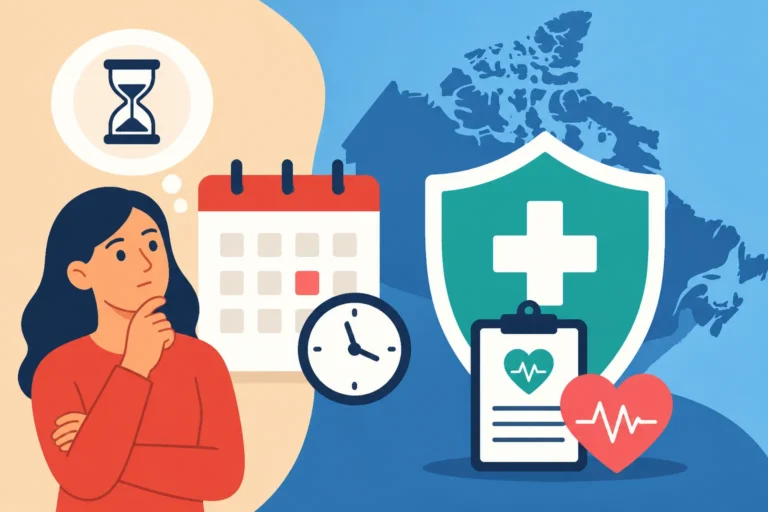
This is the part of the move that catches almost everyone off guard. In major provinces like Ontario and British Columbia, there has historically been a three-month waiting period before your provincial coverage kicks in. While some provinces have waived this at various times due to public health crises, you must assume it exists. For those first 90 days, you are essentially a "tourist" in the eyes of the medical system. If you end up in the ER with a kidney stone or a broken arm during this window, the hospital will mail you a bill for thousands of dollars.
The Newcomer Waiting Period for Provincial Health Coverage in Canada (2027) explains the logistics of this gap. It is a period of high anxiety for many expats. Some families have lived in "health bubbles," terrified of their children getting a fever or falling off a bike before day 91. The provincial government expects you to have your own private arrangements during this time, and they will not retroactively pay for bills incurred before your official start date.
Surviving the First 90 Days Safely
During this vulnerable window, you absolutely cannot afford to go uninsured. This is the primary scenario where I recommend looking at a provider like SafetyWing. They specialize in nomadic and expat-style coverage that can be started the moment you leave your home country. Having a policy through SafetyWing ensures that if an emergency happens in those first three months, you aren't staring down a $10,000 hospital bill that drains your "settling in" savings. It acts as a safety net that catches the costs that the Canadian government won't touch until your residency is fully established.
It’s also worth noting that the waiting period is "90 days of residency," not just 90 days since you got your visa. If you land, stay for two weeks, and then go back home to pack for a month, your clock might reset or pause depending on the province. You need to be physically present and building your "ties" to the community. During this time, keep a folder of every bill and every receipt, as you may need to prove your arrival date to the health ministry later.
Risks of Being Uninsured During Transition
The "it won't happen to me" mindset often fails spectacularly. A simple appendectomy in a Canadian hospital can cost upwards of $15,000 for an uninsured patient. Even a visit to a walk-in clinic for a sinus infection can cost $150 just to talk to the doctor, plus another $80 for the medication. For a family of four, these small costs add up quickly. Without a bridge like SafetyWing, you are essentially gambling with your financial future the moment you step off the plane.
Moreover, if you have pre-existing conditions, the waiting period is even more complex. You should bring at least a three-to-six-month supply of any maintenance medications from your home country, along with copies of your medical records. Do not wait until you are in Canada to realize your prescription has run out and you have no way to see a doctor without paying "out-of-province" rates. What Happens If I Get Sick During the Health Coverage Waiting Period in Canada details the specific steps to take if an emergency strikes before your card arrives.
Why Private Health Insurance is Not Optional
In Canada, private health insurance isn't a luxury for the wealthy; it’s a standard part of life for almost every resident. Since the provincial plans are so specific about what they don't cover, most Canadians rely on "Extended Health" plans. If you see a Canadian going to the dentist for a cleaning or picking up a new pair of glasses, they aren't using their government health card; they are using a private insurance card, usually provided through their employer.
If you are a freelancer, a digital nomad, or starting your own business, you won't have an employer to hand you a benefits package. This is where you must be proactive. Companies like SafetyWing are particularly useful for the "independent" class of expats who need continuous coverage that follows them regardless of who they are working for. Whether it's for emergency medical needs or eventually supplementing a local plan, private insurance is what makes the Canadian lifestyle affordable.
| Feature | Provincial Plan (e.g., OHIP/MSP) | Private Insurance (Individual/Employer) |
|---|---|---|
| Hospital Stays | Covered (Standard Ward) | Covered (Semi-Private or Private Room) |
| Doctor Visits | Covered | Not usually needed (Public covers this) |
| Prescription Drugs | Not Covered (usually) | Covered (80-100% typically) |
| Dental Care | Not Covered | Covered (Basic and Major) |
| Vision Care | Not Covered | Covered (Exams and Hardware) |
| Physiotherapy | Not Covered (mostly) | Covered (up to a yearly limit) |
| Ambulance Fees | Partial or No Coverage | Usually Covered |
Employer-Provided Group Benefits
If you have secured a job before arriving or find one quickly, your employer will likely offer a group benefits plan after a probationary period (often 3 to 6 months). These plans are a godsend. They typically cover 80% to 100% of drug costs, dental cleanings, and even things like "lifestyle" benefits (mental health counseling or gym memberships). However, there is often a gap between when you start your job and when the benefits kick in.
You must read the fine print of these contracts. Some plans have a "co-pay," meaning you pay $5 or $10 per prescription, while others have a "deductible" you must hit before they start paying. If you are switching jobs in the future, remember that your health benefits end on your last day of work. For the gap between jobs, having an independent plan or a flexible option like SafetyWing can prevent you from being "uncovered" for your dental or drug needs during a career transition.
Individual Private Plans for Newcomers
If you are not moving for a specific job—perhaps you are on a Spousal Open Work Permit or an International Experience Canada (IEC) visa—you are responsible for your own extended coverage. You can purchase "Newcomer to Canada" plans from big Canadian insurers, but they can be incredibly pricey and rigid. Many expats prefer to maintain a global health policy that offers more flexibility. How to Get Private Health Insurance to Cover the Waiting Period in Canada breaks down the comparison between local Canadian brokers and international providers.
When choosing a plan, look specifically at the "Emergency Medical" limit. You want at least $100,000 to $500,000 in coverage. While $50,000 sounds like a lot, it disappears in two days in an Intensive Care Unit. Also, check if the plan includes "Repatriation of Remains" or "Emergency Evacuation," which are standard in expat-focused plans like SafetyWing but often missing from basic local policies. These are the "worst-case scenario" features that you hope to never use but will be eternally grateful for if the unthinkable happens.
Navigating the System: Finding a Doctor and Using Clinics
Once you have your provincial card and your private insurance, the next hurdle is actually using the system. This is the part of the veteran expat experience that involves the most complaining. Canada is currently facing a massive shortage of family doctors. In cities like Toronto, Vancouver, or Ottawa, it can take months, if not years, to find a primary care physician who is "taking new patients." You don't just walk into a clinic and pick a doctor; you often have to join a centralized waiting list.
How to Find and Register with a Family Doctor in Canada is perhaps the most practical guide you will need. In Ontario, you register with a service called Health Care Connect. They assign you a "Care Connector" who tries to find a doctor in your postal code. The reality? You will likely be using walk-in clinics for a long time. These are clinics where you show up, wait in a room with twenty other people, and see whatever doctor is on duty that day. It's not ideal for continuity of care, but it is how the system functions for millions of people.
The Walk-In Clinic Culture
Walk-in clinics are the backbone of the Canadian system for those without a family doctor. You don't need an appointment, but you do need patience. I’ve spent many Saturday mornings sitting in a plastic chair in a strip-mall clinic in Mississauga, waiting three hours for a five-minute consultation. When you go, you must bring your provincial health card. If you don't have your card yet, you will be asked to pay a "private" fee upfront, usually between $80 and $150.
If you have a private insurance plan like SafetyWing, you should keep your digital ID card ready on your phone. While walk-in clinics rarely "direct bill" international insurance, you can pay the fee, get a detailed medical report and receipt, and then claim it back later. This is a crucial distinction: in Canada, public doctors bill the government directly, but for anything private, you are usually the middleman for the paperwork.
Specialized Care and the Referral Loop
One aspect of the Canadian system that frustrates expats from "private-heavy" countries is the "Gatekeeper" model. You cannot simply call a dermatologist because you have a weird mole, or an obstetrician because you are pregnant. You must first see a family doctor or a walk-in clinic doctor to get a "referral." The GP decides if your case warrants a specialist's time.
How Specialist Referrals Work in the Canadian Health System explains why this leads to long wait times. Once the referral is sent, you might wait weeks just to get a phone call with an appointment date, and that appointment might be three months away. This is the trade-off for the "free" system: high-quality care, but significant delays for non-emergency issues. If your situation is life-threatening, you go to the Emergency Room (ER) at a hospital like Mount Sinai or Toronto General, where the triage system ensures you are seen immediately.
Prescription Drugs and the Pharmacy System
In many countries, you can buy a wide range of medications over the counter. In Canada, the "behind the counter" list is much stricter. Even high-strength ibuprofen or certain allergy medications require a talk with the pharmacist. When you get a prescription from a doctor, you take it to a pharmacy (like Shoppers Drug Mart, Rexall, or the pharmacy inside a Loblaws or Costco).
Because Canada doesn't have a universal "Pharmacare" system (though this is a major political topic in 2026), the cost of drugs can be high. Are Prescription Medications Expensive in Canada? provides a breakdown, but generally, you are looking at two costs: the price of the drug itself and the "dispensing fee." The dispensing fee is what the pharmacy charges to process the script, usually between $10 and $13. If you have five different prescriptions, you are paying that fee five times.
Understanding Pharmacare and Subsidies
Some provinces have "safety net" programs for drug costs, but they are usually income-tested or age-based. For example, in Ontario, the Trillium Drug Program helps people who have high drug costs relative to their income, but there is a significant deductible. If you are a young professional, you will almost certainly be relying on your private insurance to cover these costs. Most employer plans use a "drug card" system where the pharmacy bills the insurance company directly, and you only pay the 20% remaining balance.
If you are using an international plan like SafetyWing for your initial months, you will likely pay the full price at the pharmacy and then submit the receipt for reimbursement. Pro tip: Always ask the pharmacist for the "generic" version of a drug. It is the same chemical formula but can be 50% to 70% cheaper than the brand-name version. Canadian pharmacists are generally required to offer the generic version unless the doctor specifically writes "no substitutions" on the script.
The Role of the Pharmacist
Pharmacists in Canada have a much broader scope of practice than in many other countries. In some provinces, they can now prescribe medications for "minor ailments" like urinary tract infections, cold sores, or skin rashes. This is a huge win for newcomers because it saves you a three-hour wait at a walk-in clinic. If you have a minor issue, go to the pharmacy counter first and ask if the pharmacist can assess you. It is often faster, and the consultation fee (if any) is usually covered by the province or your private plan.
Dental and Vision Care: The Missing Pieces
It is a running joke among expats that in Canada, your teeth and eyes are not considered part of your body by the government. Unless you are in a situation where a dental infection is life-threatening and requires hospital surgery, you are on your own for dental care. A standard check-up and cleaning in a city like Toronto can easily cost $250 to $400. If you need a root canal or a crown, you are looking at $1,500 to $2,500.
This is why Understanding Dental Care Costs and the Canadian Dental Care Plan is one of the most visited pages for newcomers. While the federal government has introduced a "Canadian Dental Care Plan" (CDCP), it is currently targeted at seniors, children, and people with disabilities who have a low household income. Most working-age expats will not qualify and must rely on private insurance.
Finding a Dentist and Optometrist
Finding a dentist is much easier than finding a family doctor. Because it's a private, fee-for-service system, dentists are competing for your business. You will see dental offices in almost every shopping plaza. Most offer "Direct Billing," meaning they will send the bill to your insurance company (if it’s a Canadian provider) and you just pay the difference. If you are using a plan like SafetyWing, you will pay the dentist and then file a claim.
Vision care is similar. Optometrists are private providers. You should have an eye exam every two years, which usually costs around $100 to $150. Provincial plans generally only cover eye exams for children under 18 and seniors over 65. If you need glasses or contact lenses, be prepared for high prices; Canada has a bit of a monopoly in the eyewear market, though online retailers like Clearly are making it more affordable.
Emergency Situations: What You Need to Know
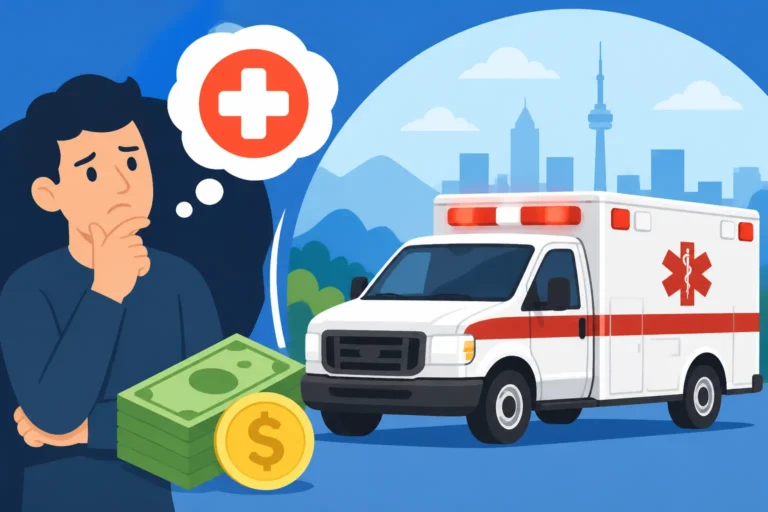
In an emergency, you call 911. This connects you to police, fire, or ambulance services. However, there is a major misconception that the ambulance is "free." In most provinces, there is a co-pay for ambulance services, even for residents with a health card. In Ontario, if the ambulance is deemed "medically necessary," you pay a flat fee of about $45. If it is deemed not medically necessary, you could be billed $240 or more.
If you are a newcomer without your provincial health card yet, that ambulance bill could be significantly higher—sometimes $500 to $1,000 depending on the distance and the level of care provided. Understanding Emergency Numbers (911) and Ambulance Fees in Canada provides a province-by-province breakdown of these costs. This is yet another reason why having your SafetyWing policy active from day one is non-negotiable.
Emergency Room Triage
When you arrive at the ER, you will see a triage nurse first. They are not checking your insurance; they are checking your heart rate, oxygen levels, and the severity of your injury. You will be assigned a priority level from 1 (immediate life-threat) to 5 (non-urgent). If you go to the ER with a minor cut or a flu, you will wait behind everyone with a level 1-3 priority. It is not uncommon to wait 8 to 12 hours in a Canadian ER for non-life-threatening issues.
If you have a minor emergency, look for an "Urgent Care Centre" instead of a full hospital ER. They handle things like stitches, basic fractures, and high fevers, and the wait times are usually much shorter. Emergency Medical Care in Canada: What Every Newcomer Needs to Know details how to find these centers in your specific city.
Mental Health Resources
Mental health is increasingly integrated into the Canadian healthcare conversation, but access remains a challenge. While a psychiatrist (a medical doctor) is covered by provincial plans, a psychologist or a counselor is generally not. Most people access therapy through their employer's private insurance or pay out-of-pocket, with rates ranging from $150 to $250 per hour. If you are struggling with the "relocation blues" or more serious issues, How to Access Mental Health Services in Canada as a Newcomer lists free community resources and crisis lines like 9-8-8, which is Canada’s national suicide prevention and mental health crisis line.
Practical Checklist for Your First 90 Days
To make sure you don't fall through the cracks, follow this step-by-step sequence the moment you arrive. Don't wait until you "feel settled" to start the healthcare paperwork; the clock only starts when you take action.
- Secure Temporary Insurance: Before you even leave, ensure you have a policy like SafetyWing to cover that initial 90-day gap and any travel days.
- Gather Your Documents: You will need your passport, your work permit/PR papers, and "Proof of Residency." The best proof is a utility bill (hydro or gas), a bank statement with your Canadian address, or a formal lease agreement.
- Visit the Service Centre: Go to the nearest provincial service office (e.g., ServiceOntario) to apply for your health card. Get there 30 minutes before they open to avoid the worst of the queues.
- Keep Your Paperwork: You will be given a "Transaction Record" or a temporary paper. This is your proof of coverage until the plastic card arrives in the mail.
- Join the Waitlists: Immediately register for your province's doctor-finding service. In Ontario, that’s Health Care Connect; in BC, it’s the Health Connect Registry.
- Locate Your Nearest Walk-In: Find the nearest walk-in clinic and Urgent Care Centre to your home before you need them. Save their phone numbers and hours in your phone.
Moving to Canada is a massive undertaking, and the healthcare system is often the most confusing part of the transition. By understanding that the public system has limits and that private coverage is a necessary bridge, you can focus on enjoying your new life in the Great White North without the constant fear of a medical bill. Whether you are using SafetyWing for your first three months or navigating the long-term world of employer benefits, being informed is your best medicine.
Disclaimer
The information provided in this guide is for informational purposes only and does not constitute medical, legal, or financial advice. Healthcare regulations, provincial policies, and insurance coverage details in Canada are subject to change. Always consult with official government sources (such as Health Canada or your provincial Ministry of Health) and a qualified insurance professional before making decisions regarding your health coverage. The author and publisher are not responsible for any actions taken based on the content of this article.