Is It Cheaper to Get Dental Work Done in Canada?
One of the biggest surprises for newcomers and visitors to Canada, beyond the sheer beauty of the landscapes, is often the cost of dental work. Unlike routine visits to the family doctor or emergency room care, dental services aren't typically covered by Canada's provincial health plans, leaving many wondering if getting a tooth fixed here is going to break the bank. This guide aims to pull back the curtain on Canadian dental costs, offering a realistic comparison to other countries, and helping you understand your options for managing these expenses.
The Reality of Dental Care Costs in Canada for Newcomers and Visitors
When you first arrive in Canada, you might be excused for thinking that all healthcare is "free" or universally covered, given the reputation of our public system. But that's a common misconception that often leads to a rude awakening when you face your first dental bill. Getting your head around how dental care works here is crucial for your financial peace of mind.
Why Dental Care Isn't "Free" in Canada
Let's be blunt: dental care, for the most part, is not covered by Canada's provincial health plans. This means that while your provincial health card (like OHIP in Ontario, MSP in British Columbia, or RAMQ in Quebec) is your golden ticket for seeing a doctor or going to a hospital, it won't help you with that pesky cavity or a much-needed cleaning. This can be a huge shock, especially for folks coming from countries where dental care is fully integrated into the public healthcare system. The Canadian public healthcare system generally focuses on medical services provided by doctors and hospitals, not elective dental work or even most necessary dental procedures outside of a hospital emergency setting. If you want to dive deeper into what is covered, check out our guide on Understanding What Provincial Health Plans Do and Don't Cover in Canada.
The frustration is real. Many expats arrive expecting a seamless transition, only to find a gaping hole (pun intended!) in their healthcare coverage when it comes to their teeth. It's an administrative hurdle that adds to the already overwhelming list of things to figure out in a new country. Essentially, Canada operates a two-tiered system for health: publicly funded medical care and a largely privately funded dental care system.
Common Dental Procedures and Their Estimated Costs
The cost of dental procedures in Canada can vary quite a bit depending on your province, the specific clinic, and even the individual dentist. Urban centers, particularly in major cities like Toronto or Vancouver, tend to have higher prices compared to smaller towns. Dentists generally follow a fee guide set by their provincial dental associations, but they are not strictly bound by it, so fees can fluctuate.
To give you a clearer picture, here's a general idea of what you might expect to pay for some common procedures. Please remember these are estimates and actual costs could be higher or lower.
| Procedure | Estimated Cost Range (CAD) | Notes |
|---|---|---|
| Routine Check-up & Cleaning | $150 – $300 | Includes examination, scaling, polishing, and sometimes fluoride treatment. |
| Simple Filling (Amalgam) | $150 – $350 | Cost varies based on size and number of surfaces. |
| Simple Filling (Composite) | $200 – $450 | Tooth-coloured fillings, generally more expensive than amalgam. |
| Tooth Extraction (Simple) | $200 – $400 | Non-surgical extraction, local anesthetic included. |
| Root Canal Therapy | $800 – $2,500+ | Varies significantly by tooth (front vs. molar) and complexity. |
| Crown | $900 – $2,000+ | Price depends on material (porcelain, ceramic, gold) and tooth location. |
| Dental Implant (per tooth) | $3,000 – $6,000+ | This usually includes the implant, abutment, and crown, but can vary widely. |
| X-rays (set) | $30 – $100 | Often included in a routine check-up, or billed separately for specific needs. |
As you can see, these costs add up quickly. A simple cavity can become a significant expense, and more complex procedures like root canals or crowns are major financial commitments. This is why understanding your options for coverage or proactive management is so important. For a broader overview of healthcare costs, you might find our guide on The Cost of Healthcare in Canada: A Complete Breakdown for Newcomers (2026) helpful, even though it focuses more on medical services.
Comparing Canadian Dental Costs to Other Countries
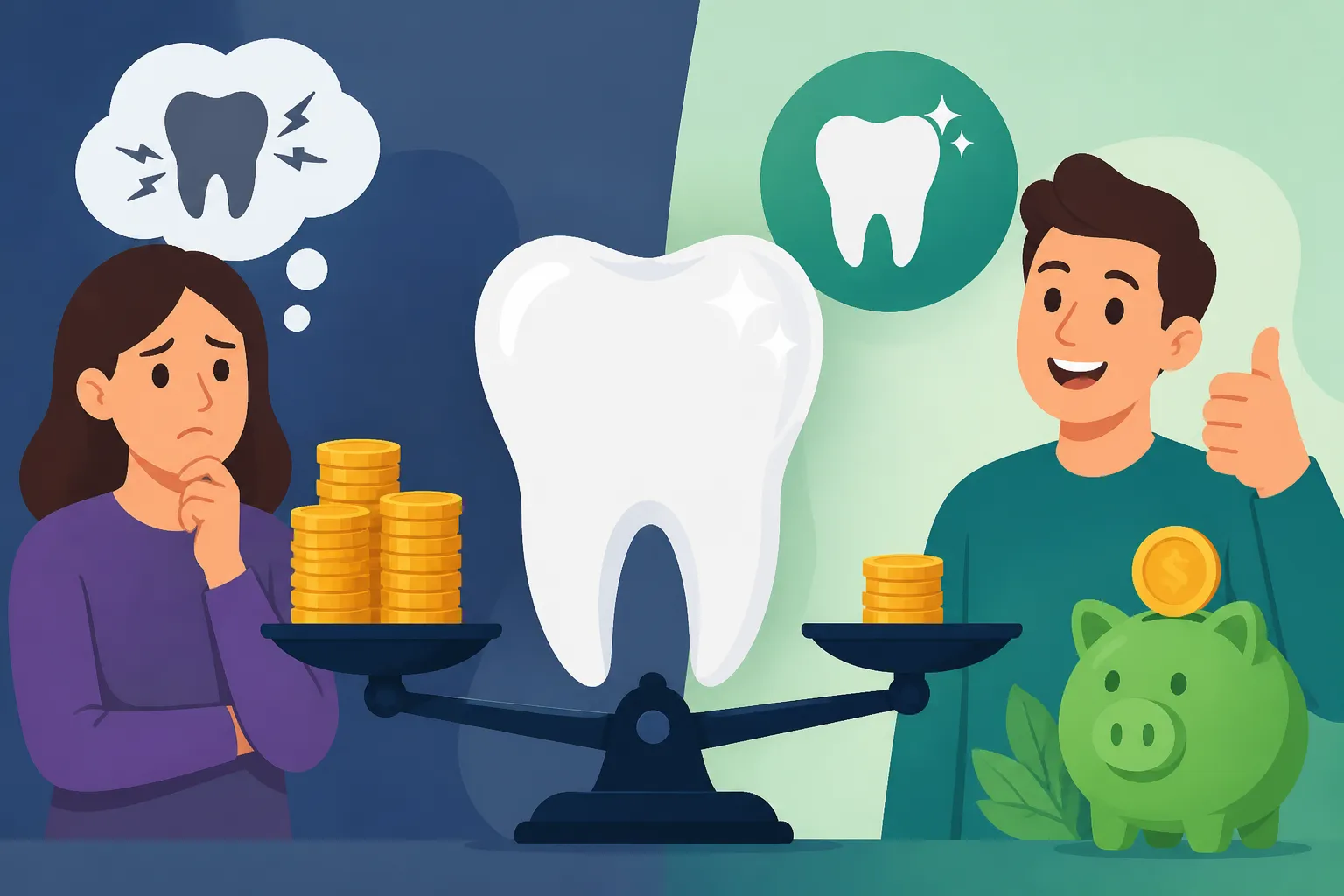
So, is Canada cheaper for dental work? The answer, like most things in life, is "it depends." It largely hinges on where you're coming from and what kind of dental work you need.
When Canada Might Be Cheaper
If you're emigrating from a country with notoriously high dental costs, such as the United States, then yes, Canada might indeed feel like a bargain. Dental fees in the US, particularly for more complex procedures, can be significantly higher, often double or triple what you'd pay in Canada. For example, a root canal and crown that might cost $3,000-$5,000 USD in some parts of the US could realistically be $2,000-$3,000 CAD (roughly $1,500-$2,200 USD at current exchange rates) in Canada.
This comparison is particularly true for routine maintenance like cleanings and basic fillings. If your home country's private insurance system is less robust or out-of-pocket expenses are the norm, Canada's dental fee guides, while still considerable, can offer a more predictable and often lower price point. It's all about context. For example, some individuals who live near the Canadian-US border might even cross over for certain procedures if they have Canadian insurance or find the Canadian rates more favourable for specific treatments.
When Canada Might Not Be Cheaper
On the flip side, if you're coming from a country with universal dental care (which is quite common in many parts of Europe) or from regions known for "dental tourism" due to lower labour and material costs (like Mexico, Costa Rica, parts of Eastern Europe, or India), then Canada will likely feel very expensive.
In these countries, you might find that basic check-ups and even major procedures are significantly cheaper, sometimes by 50% or more, or fully covered by a state system. For instance, a crown that costs $1,500 CAD here might be available for $500 CAD in certain dental tourism destinations. The exchange rate plays a huge role here as well; a strong Canadian dollar can make travel and dental work abroad seem more appealing, while a weaker dollar might make the savings less significant.
Furthermore, Canada's overall cost of living, especially in major cities, is quite high. This impacts everything, including the operational costs for dental clinics, which then gets passed on to the patient. So, while medical care is largely publicly funded and thus appears "free" at the point of service, dental care very much reflects the higher cost of doing business in Canada. You might want to consider Public vs Private Healthcare in Canada: What Newcomers Need to Know to fully grasp the nuances.
Navigating Dental Coverage Options in Canada
Since provincial health plans won't cover your dental needs, understanding how to get some form of coverage is paramount. Luckily, there are a few avenues you can explore, depending on your situation as a newcomer or visitor.
Private Dental Insurance and Employer Benefits
For many working Canadians, dental coverage comes as a perk through their employer's benefits package. These plans typically cover a percentage of dental costs – often 80% for basic services (like cleanings and fillings) and 50% for major services (like crowns, bridges, and root canals), up to an annual maximum. If you're lucky enough to land a job with good benefits, this is by far the most common and convenient way to manage dental expenses. You'll simply pay the remaining percentage (the co-payment) directly to the dentist or the clinic will bill your insurance directly, and you'll pay your portion.
If you don't have employer-sponsored benefits, you can explore purchasing individual private dental insurance. This can be a bit more complex and potentially expensive, as premiums can be high, and there might be waiting periods before certain procedures are covered. Some plans also have annual limits or specific exclusions, especially for pre-existing conditions. It's crucial to shop around and compare plans carefully. Our article on How to Use Private Health Insurance and Employer Benefits in Canada offers a comprehensive look at navigating these options. Additionally, for a broader understanding of private coverage, you might find our guide on Understanding Supplementary Health Insurance (Dental, Vision, Drugs) in Canada helpful.
Understanding the Canadian Dental Care Plan (CDCP)
In a significant move to make dental care more accessible, the Canadian government has recently introduced the Canadian Dental Care Plan (CDCP). This federal initiative aims to provide dental coverage for eligible Canadian residents who do not have access to private dental insurance.
The CDCP is being rolled out in phases, with eligibility initially focused on seniors, children under 18, and persons with a valid Disability Tax Credit certificate, before expanding to all eligible Canadian residents by 2025. To qualify, individuals must have an adjusted family net income of less than $90,000, be a Canadian resident for tax purposes, and not have access to private dental insurance.
The plan covers a wide range of services, including preventive care (cleanings, examinations), diagnostic services (X-rays), restorative services (fillings), endodontic services (root canals), prosthodontic services (dentures), and even some oral surgery. However, the exact coverage percentage will depend on your family's adjusted net income, ranging from 100% for those with incomes under $70,000, to 40% for those with incomes between $80,000 and $89,999.
This is a game-changer for many, finally offering some relief from the high out-of-pocket costs. Keep a close eye on the official government website for the most up-to-date eligibility and application details. For a deeper dive, check out our piece on Understanding Dental Care Costs and the Canadian Dental Care Plan.
Options for Visitors and Those Without Coverage
If you're a visitor to Canada or a newcomer still in a waiting period for provincial health coverage (which can be up to three months in some provinces, as detailed in The Newcomer Waiting Period for Provincial Health Coverage in Canada (2027)), dealing with dental emergencies can be particularly stressful. Your options for non-emergency dental care without insurance are limited to paying out of pocket.
For emergencies, your provincial health card won't cover a dental emergency at a private clinic. However, if a dental issue is severe enough to require hospital intervention (e.g., a serious infection requiring IV antibiotics, or trauma to the face), the hospital emergency room will treat you. Be warned, though, that a hospital emergency room visit won't fix your tooth; they will stabilize your condition, manage pain, and refer you to a dentist for follow-up. And if you don't have provincial coverage, even that emergency room visit might have a fee, similar to How Much Does a Doctor Visit Cost in Canada Without Coverage?.
This is where travel insurance becomes incredibly important. Many travel insurance policies, like those offered by providers such as SafetyWing, include coverage for emergency dental work up to a certain limit. This type of insurance is designed to protect you from unexpected medical and dental costs while you're away from your home country or during initial periods in a new country. It's a lifesaver if you suddenly develop a severe toothache or suffer an accident that affects your teeth. Always read the fine print to understand what is covered, the limits, and any deductibles. Our article on Do I Need Private Health Insurance When I First Arrive in Canada? offers more insights into covering those initial gaps. Also, for general emergencies, you'll want to read up on Emergency Medical Care in Canada: What Every Newcomer Needs to Know.
Tips for Managing Dental Expenses in Canada
Even with the new CDCP or private insurance, managing dental costs can still be a burden. Here are some practical tips to help you navigate the system and keep your smile (and your wallet) healthy.
Finding Affordable Dental Care
It takes a bit of legwork, but there are ways to find more affordable dental care in Canada. Don't be shy about asking questions!
- Shop Around and Compare Quotes: Dentists are independent practitioners, and their fees can vary. If you need a significant procedure, don't hesitate to call a few different clinics in your area and ask for an estimated cost. Many will be happy to provide this information, often requiring an initial consultation fee.
- Dental Schools: Major universities with dental faculties often operate clinics where students, under the close supervision of licensed dentists, provide care at a reduced rate. This can be an excellent option for more complex or extensive treatments. Wait times can sometimes be longer, but the savings can be substantial. For example, the University of Toronto, McGill University, and the University of British Columbia all have dental clinics open to the public.
- Community Dental Clinics & Public Health Units: Some cities and regions have community dental clinics or public health programs that offer services on a sliding scale based on income or for specific populations (e.g., children, low-income individuals). Check with your local public health unit or municipality for programs in your area.
- Ask for Fee Schedules: You have the right to ask your dentist for their fee schedule before treatment begins. This transparency can help you understand costs and plan accordingly.
Proactive Dental Health and Prevention
This might sound obvious, but prevention truly is the best medicine, especially when it comes to dental care in Canada. Avoiding costly procedures down the line is the most effective way to save money.
- Regular Check-ups and Cleanings: Don't skip these! Even if you have to pay out of pocket, a regular check-up and professional cleaning (usually once or twice a year) can catch minor issues before they become major, expensive problems. A small filling now is far cheaper than a root canal later.
- Excellent Oral Hygiene at Home: Brushing twice a day, flossing daily, and using mouthwash can make a world of difference. Investing in a good electric toothbrush or water flosser can also be beneficial. Remember that even the cost of Prescription Medications and Pharmacies in Canada: The Complete Guide will tell you that certain oral hygiene products are over-the-counter and widely available.
- Healthy Diet: Limiting sugary drinks and foods can significantly reduce your risk of cavities. Canada's grocery stores offer a bounty of fresh produce, making it easier to maintain a tooth-friendly diet.
- Consider Dental Travel (If Feasible): For extremely expensive procedures like multiple implants or extensive cosmetic work, some people actually choose to travel to countries where these services are much cheaper, if they don't have comprehensive coverage here. Factor in travel costs and recovery time, of course.
By being informed and proactive, you can definitely minimize the financial impact of dental care in Canada. It requires planning and perhaps a shift in expectations, but it's entirely manageable.
Disclaimer
The information provided in this guide is intended for general informational purposes only and does not constitute professional dental, medical, or financial advice. Dental costs and coverage options in Canada are subject to change and can vary significantly by province, individual circumstances, and specific dental clinics. Always consult with a qualified dental professional, insurance provider, or financial advisor for advice tailored to your personal situation. We strive to keep information current, but cannot guarantee its absolute accuracy or completeness at all times.