What Is the Difference Between a Work Permit and Permanent Residence in Canada?
Navigating the labyrinth of Canadian immigration can feel like trying to solve a Rubik's Cube blindfolded, especially when you're just starting out. One of the biggest points of confusion I hear from fellow newcomers, and honestly, something I grappled with myself, is the fundamental difference between a work permit and permanent residence. These aren't just bureaucratic terms; they define your entire experience and future in Canada, so understanding them clearly is absolutely crucial. This guide will walk you through the nuances, ensuring you can make informed decisions about your journey in the Great White North.
Demystifying the Canadian Work Permit
Let's start with the work permit, because for many, this is the first tangible step towards living and working in Canada. Think of a work permit as your temporary ticket to employment here. It's exactly what it sounds like: permission from the Canadian government to work for a specific period, under specific conditions. It doesn't grant you permanent status in the country, but it certainly opens doors.
Eligibility and Application Process for Work Permits
Getting a work permit isn't always straightforward, and the requirements can vary quite a bit depending on your situation. Generally, you’ll need a job offer from a Canadian employer, and often, that employer will need what's called a Labour Market Impact Assessment (LMIA). This is basically a government document confirming that there isn't a Canadian citizen or permanent resident available and qualified to do the job. It's a protection mechanism for the local workforce, but for you, it's an extra hoop to jump through. There are also LMIA-exempt work permits for certain professions or international agreements. If you're pondering the specifics, diving into resources like "Understanding Canadian Work Permits: LMIA and Exempt Explained (2026)" can really clarify the path.
The application itself involves gathering a mountain of documents – your passport, educational and professional credentials, a letter of employment, and sometimes a medical exam or police certificate. This can feel overwhelming, especially if you're doing it from outside Canada. It's a meticulous process, and missing even a small detail can lead to frustrating delays. Believe me, I've seen it happen to countless friends. You'll submit your application to Immigration, Refugees and Citizenship Canada (IRCC), either online or through a visa office, and then… you wait. Patience is a virtue here, my friends.
Key Characteristics and Limitations of a Work Permit
The most important thing to grasp about a work permit is its temporary nature. It has an expiry date, and unless you renew it or transition to another status, you'll eventually need to leave Canada. Many work permits are also employer-specific, meaning you can only work for the employer named on your permit, in the specific role and location listed. This can feel quite restrictive; imagine if you found a better opportunity or if your current job wasn't working out – you can't just switch jobs without applying for a new work permit, which is another lengthy process. There are open work permits, which offer more flexibility, but these are usually only available under specific circumstances, such as for the spouse of a skilled worker or an international student graduating with a Post-Graduation Work Permit (PGWP).
Another crucial limitation relates to your rights and access to services. While you'll generally have access to provincial healthcare once any waiting periods are over – and yes, there are waiting periods, so do yourself a favour and check out "The Newcomer Waiting Period for Provincial Health Coverage in Canada (2026)" – your ability to truly integrate or access certain social programs might be limited. Your family members might also need their own separate permits to work or study. For instance, if you arrive on a work permit, your provincial health coverage might not kick in immediately. This is where private health insurance, like a plan from Cigna Global, can be an absolute lifesaver. It bridges that gap, ensuring you're not caught off guard by unexpected medical bills during those vulnerable first few months.
Unpacking Canadian Permanent Residence
Now, let's talk about permanent residence. This is often the ultimate goal for many who come to Canada on temporary visas. Permanent Resident (PR) status is a much more stable and comprehensive status, granting you most of the rights and responsibilities of a Canadian citizen, with a few key exceptions (like voting or holding a Canadian passport). It signifies that Canada sees you as a long-term member of its society.
Eligibility Pathways to Permanent Residence
There isn't just one road to becoming a permanent resident; Canada offers several pathways, each with its own set of criteria. The most well-known is probably Express Entry, which manages applications for three federal economic immigration programs: the Federal Skilled Worker Program, the Federal Skilled Trades Program, and the Canadian Experience Class. If you're curious about how this whole system works, I highly recommend "How Express Entry Works for Permanent Residence in Canada (2026)". It's a points-based system, meaning your age, education, language proficiency (English and/or French), and Canadian work experience all contribute to a Comprehensive Ranking System (CRS) score. The higher your score, the better your chances of receiving an Invitation to Apply (ITA) for permanent residence.
Beyond Express Entry, Provincial Nominee Programs (PNPs) are incredibly popular. Under a PNP, a province or territory can nominate individuals who meet specific local labour market needs. This is particularly good if you have skills in demand in a particular region. For example, if Saskatchewan needs more nurses, they might have a PNP stream specifically for healthcare professionals. Each province has its own unique programs, so exploring "The Newcomer Guide to Provincial Nominee Programs (PNP) in Canada (2026)" could be very insightful. Other pathways include family sponsorship, where a Canadian citizen or permanent resident can sponsor eligible relatives, and various business or investor immigration programs. The good news is, there are usually options, but finding the right one requires a bit of research and often, expert advice.
Rights, Responsibilities, and Privileges of a Permanent Resident
Once you achieve permanent resident status, your life in Canada takes on a new level of stability. You can live, work, and study anywhere in Canada, in any profession (assuming you meet any licensing requirements), without needing a new permit. Your PR status is not tied to a specific employer, which means a tremendous amount of freedom and security. Losing a job, while always stressful, doesn't put your immigration status at immediate risk. You also gain access to most social benefits that Canadian citizens receive, including universal healthcare (without those pesky waiting periods!) and social services, and you're protected under Canadian law and the Canadian Charter of Rights and Freedoms.
With these rights come responsibilities, of course. You're expected to pay taxes, respect Canadian laws, and continuously demonstrate your commitment to living in Canada. There's a residency obligation for permanent residents, meaning you must be physically present in Canada for at least 730 days within any five-year period to maintain your status. This commitment is what sets PR apart from temporary visas; it's a mutual agreement that you're here for the long haul. And for many, this long haul eventually leads to Canadian citizenship, which is the final step in truly calling Canada home. If that's your goal, you'll want to check out "Canadian Citizenship: How to Apply After Permanent Residence (2026)".
The Core Differences: Work Permit vs. Permanent Residence
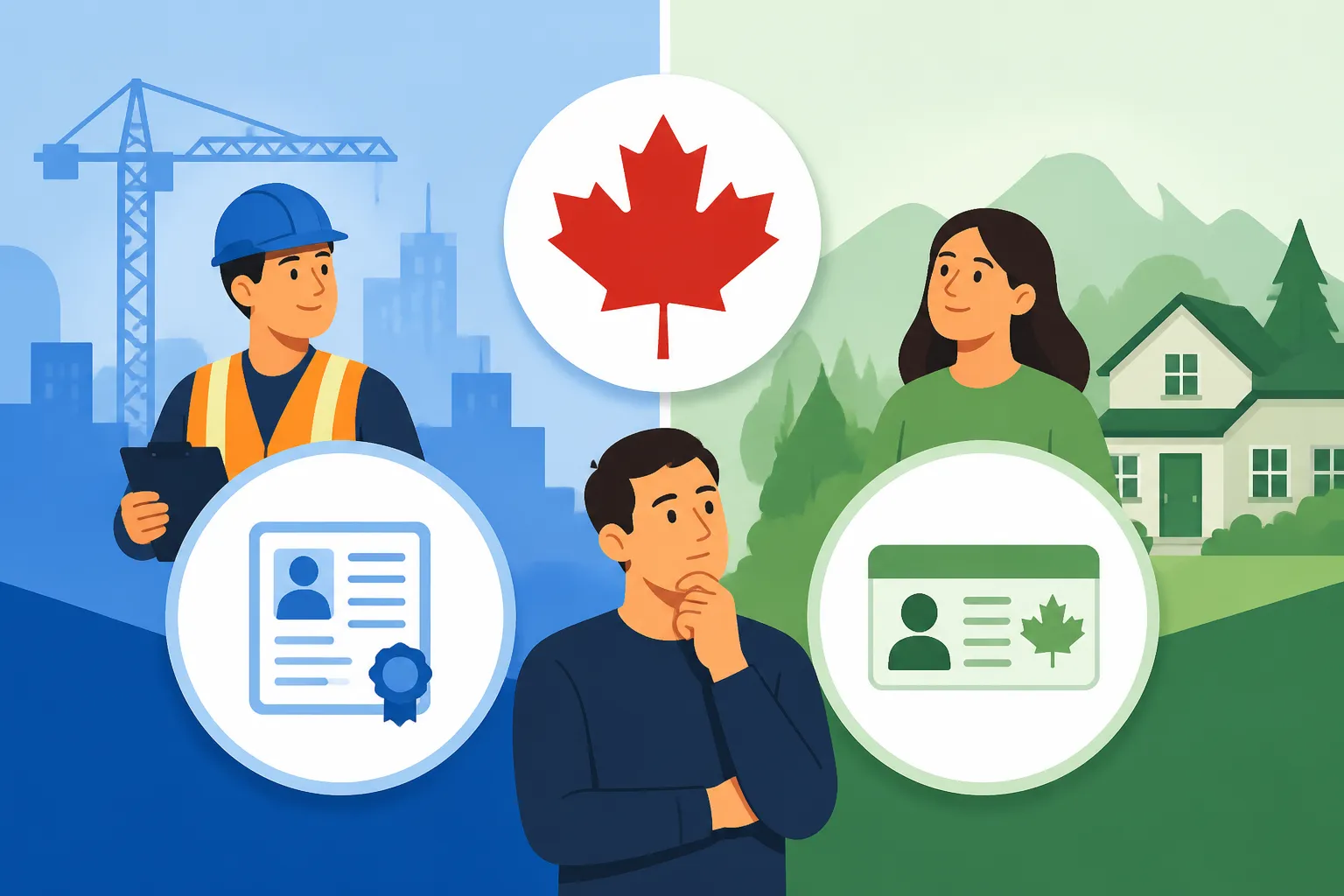
At their heart, the distinction between a work permit and permanent residence boils down to temporary vs. permanent, and limited rights vs. comprehensive rights. It’s not just about the piece of paper; it’s about your future.
Status, Rights, and Long-Term Prospects
A work permit grants you a temporary right to work in Canada. Your status is conditional and finite. This means you're always operating with an expiry date looming overhead. It can be stressful, especially when planning your life, making investments, or thinking about starting a family here. You might be restricted to one employer, making career growth or even simple job satisfaction a more complex equation. Even minor travel can sometimes feel complicated, as your re-entry is dependent on your permit's validity.
Permanent residence, on the other hand, grants you an indefinite right to live and work in Canada. Your status isn't tied to a job or a specific time frame, giving you an unparalleled sense of security and freedom. You can move across provinces, change jobs, start a business, or even go back to school without needing to apply for new permits. This stability is a game-changer for long-term planning, whether it’s buying property, enrolling your children in school, or building a retirement nest egg. It truly allows you to put down roots.
Let's put it into a table to make it clearer:
| Feature | Work Permit | Permanent Residence (PR) |
|---|---|---|
| Status Type | Temporary | Permanent |
| Duration | Fixed expiry date, requires renewal/new application | Indefinite (subject to residency obligation) |
| Right to Work | Often employer-specific, location-specific | Unlimited, anywhere in Canada, any occupation (with licensing) |
| Right to Live | Specific to purpose of permit, tied to work | Anywhere in Canada, full freedom of movement |
| Social Benefits | Provincial healthcare (after waiting period), limited access to other benefits | Full access to provincial healthcare, social services, education |
| Family Inclusion | Family members may need separate permits | Family members often included in PR application, or easier to sponsor |
| Path to Citizenship | Potential stepping stone | Direct pathway, after meeting residency criteria |
| Travel | Re-entry subject to permit validity and purpose | Freedom to travel, re-entry as PR holder (with valid PR card) |
| Security/Stability | Lower, subject to employer/permit conditions | High, protected by law, not tied to employment |
Path to Citizenship vs. Temporary Stay
The biggest conceptual difference lies in their ultimate purpose. A work permit is designed for a temporary stay. While it can often be a stepping stone towards permanent residence, it is not an inherent right to stay in Canada forever. It’s a mechanism for Canada to fill labour gaps or facilitate international exchange on a short-to-medium-term basis. If you're on a work permit and eyeing PR, you need a clear strategy to transition, which often involves accruing Canadian work experience or improving your language skills. Don't leave it to chance; research "How to Move from a Work Permit to Permanent Residence in Canada" early on.
Permanent residence, by contrast, is a formal recognition of your intention to integrate and potentially become a Canadian citizen. It’s a long-term commitment. Once you have PR, and you meet the residency requirements (meaning you've lived in Canada for a certain number of days over a specified period), you become eligible to apply for Canadian citizenship. This is the ultimate symbol of belonging, allowing you to vote, hold a Canadian passport, and fully participate in all aspects of Canadian society. It’s a journey that many newcomers aspire to complete, cementing their place in this incredible country.
Transitioning from a Work Permit to Permanent Residence
For countless newcomers, a work permit is simply the first chapter in their Canadian story. The dream, and often the reality, is to eventually transition to permanent residence. It's a strategic move, leveraging your time and experience in Canada to secure your long-term future.
Strategies and Common Pathways
One of the most common and effective strategies to bridge the gap from a work permit to PR is through Canadian work experience. Many economic immigration programs, particularly the Canadian Experience Class under Express Entry, highly value this. If you've been working full-time in a skilled occupation in Canada for at least one year, you're already in a much stronger position. This is why getting a foothold with a valid work permit, even if it feels temporary, is so important. It allows you to gain that crucial local experience. Remember, every day you work here, you're building towards that PR application.
Another vital element is language proficiency. Whether you're aiming for Express Entry or a Provincial Nominee Program, strong English and/or French skills are almost always a must. Many newcomers use their time on a work permit to improve their language abilities, either through formal classes or simply through daily immersion. It’s an investment that pays off significantly when it comes to PR applications. Moreover, some PNPs specifically target individuals who are already working in the province, making a work permit a direct pipeline to nomination. For instance, if you secure a job in Alberta, you might find an Alberta Immigrant Nominee Program (AINP) stream that perfectly matches your profile. It really highlights the importance of understanding specific provincial needs, not just federal programs.
Challenges and Considerations
While the path from work permit to PR is well-trodden, it's not without its challenges. The most significant is undoubtedly the competition. Immigration programs are popular, and the number of available spots can be limited, especially for highly sought-after streams. This means you need to be strategic, keep your credentials up-to-date, and be ready to apply as soon as you meet the eligibility criteria. It also means actively managing your profile, like in Express Entry, to ensure your Comprehensive Ranking System (CRS) score is as high as possible.
Another consideration is the constantly evolving nature of immigration policies. What might be a strong pathway today could change tomorrow, making it essential to stay informed. Rely on official government sources and reputable immigration consultants. Financial planning is also critical. Moving and settling in Canada, especially if you're bringing a family, can be expensive. From initial visa fees to the cost of moving your household goods – perhaps with the help of a service like Sirelo – it all adds up. Understanding "Understanding the Cost and Timeline of the Immigration Process in Canada" is paramount. Remember, this isn't just a move; it's an investment in your future.
Disclaimer
The information provided in this article is intended for general guidance only and does not constitute legal advice. Immigration policies and regulations in Canada are complex and subject to change. For personalized advice, it is highly recommended to consult with a regulated Canadian immigration consultant or a qualified legal professional.