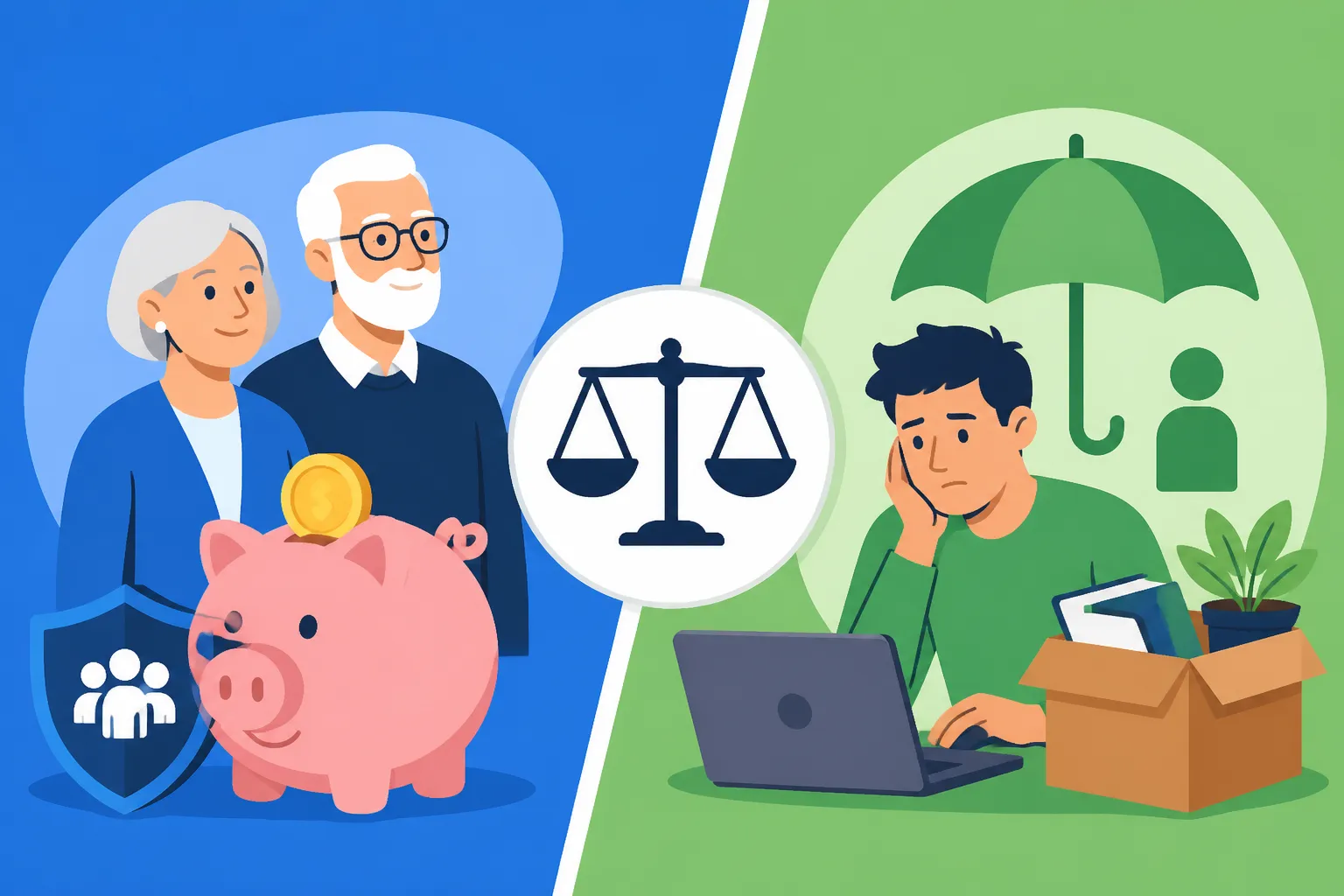
What Is the Difference Between CPP and EI in Canada?
When you first arrive in Canada, navigating the maze of government services and payroll deductions can feel like trying to solve a Rubik's Cube blindfolded. Many newcomers find themselves scratching their heads when they see "CPP" and "EI" vanish from their paycheques, wondering what these acronyms even mean and what they're actually paying for. This guide is here to shed light on these two crucial Canadian systems, explaining the fundamental differences between the Canada Pension Plan (CPP) and Employment Insurance (EI), so you can understand your contributions and, more importantly, the vital benefits they offer.
Unpacking CPP: Your Future Retirement Safety Net
Let's start with CPP, the Canada Pension Plan. Think of this as a mandatory, government-run pension program designed to provide you with a modest income during your retirement years, or if you face a serious long-term disability. It's not just for you; it also offers benefits to your surviving spouse or common-law partner and dependent children should you pass away. It's a foundational pillar of Canada's social safety net, ensuring that everyone who contributes has some financial security later in life.
What is the Canada Pension Plan CPP?
At its core, the Canada Pension Plan (CPP) is a contributory social insurance program. This means that the benefits you receive are directly tied to the contributions you've made throughout your working life. It's a system where current workers help fund current retirees and beneficiaries, with the aim that when you retire, a new generation of workers will fund your benefits.
Every working Canadian, once they turn 18 and earn more than a minimum amount (the basic exemption, which is $3,500 annually for 2024), contributes to CPP. These contributions are automatically deducted from your paycheque if you're an employee, or calculated and paid when you file your taxes if you're self-employed. The money collected isn't just sitting in a vault; it's invested by the CPP Investment Board, aiming to grow the fund to ensure its long-term sustainability. The idea is that it provides a base level of income that helps alleviate poverty among seniors and those with disabilities, without being intended as your sole source of income in retirement.
Who Pays into CPP and How Much?
This is where the structure differs significantly from other programs you might be familiar with. Both employees and their employers contribute to the Canada Pension Plan.
As an employee, a percentage of your earnings, up to a certain maximum, is deducted from your pay. For 2024, the employee contribution rate is 5.95% on earnings between $3,500 (the basic exemption) and the maximum pensionable earnings (which is $68,500 for 2024). This means that for earnings above $68,500, you stop contributing to CPP. The maximum employee contribution for 2024 is $3,867.50. You'll see this deduction clearly itemized on your pay stub, often abbreviated as "CPP." Understanding these deductions is a key part of Understanding CPP, EI and Payroll Deductions for Employees in Canada.
Your employer matches your contribution dollar-for-dollar. So, if you contribute $100, your employer also contributes $100 on your behalf. This is a significant benefit for employees, as it effectively doubles the contributions being made towards your future pension.
If you are self-employed in Canada, things are a little different but no less important. You are responsible for paying both the employee and employer portions of CPP contributions. This means your contribution rate is effectively doubled, to 11.9% for 2024, on your earnings between the basic exemption and the maximum pensionable amount. For many newcomers, especially those looking to The Complete Guide to Freelancing in Canada as a Newcomer or start a business, this can be a big surprise when it comes time to file taxes. It’s crucial to factor this into your financial planning. This is also a good example of why services like Taxes for Expats can be invaluable, as they help navigate these specific self-employment tax obligations, ensuring you understand how to budget and pay your contributions correctly when you Filing Your Tax Return with the CRA in Canada: The Complete Walkthrough (2027).
What Benefits Does CPP Provide?
The Canada Pension Plan offers several types of benefits, extending beyond just your retirement:
- Retirement Pension: This is the most common benefit, providing a regular monthly income to eligible contributors when they retire. You can start receiving your CPP retirement pension as early as age 60 or as late as age 70, though the standard age is 65. If you start earlier, your payments will be reduced; if you defer, they'll be increased. The amount you receive depends on how much and for how long you've contributed to the plan.
- Disability Benefits: If you become severely and prolonged disabled to the extent that you can't work regularly, and you've made enough contributions, you may be eligible for CPP disability benefits. This provides financial support during a challenging time.
- Survivor Benefits: Should a contributor pass away, the CPP provides benefits to their eligible survivors. This includes:
- Survivor's Pension: A monthly payment to the deceased contributor's spouse or common-law partner.
- Children's Benefit: Monthly payments for dependent children of the deceased contributor.
- Death Benefit: A one-time payment to the deceased's estate or a designated individual to help cover funeral expenses.
- Post-Retirement Benefit (PRB): If you continue to work while receiving your CPP retirement pension and continue to contribute to CPP, you will earn a Post-Retirement Benefit. This effectively increases your monthly pension payment.
These benefits are designed to offer a basic layer of financial protection throughout various life stages, making CPP a fundamental part of the Canadian social welfare system.
Demystifying EI: Your Short-Term Income Protection
Now, let's talk about Employment Insurance, or EI. While CPP looks towards your long-term future, EI is all about providing temporary financial assistance during specific short-term life events that prevent you from working. It’s a crucial safety net for many, covering situations like job loss, illness, or welcoming a new child.
What is Employment Insurance EI?
Employment Insurance (EI) is another mandatory program, but its purpose is quite different from CPP. EI provides temporary income support to individuals who have lost their job through no fault of their own (e.g., layoff, shortage of work) or who are unable to work due to specific life circumstances. These benefits help you manage your finances until you can return to work, giving you some breathing room to find a new job or recover from an illness or care for a new family member.
Unlike CPP, which focuses on retirement and long-term disability, EI is explicitly designed for short-term income replacement. It's a way for the government to help stabilize the workforce and provide crucial support during transitional periods. The funds for EI are collected through premiums paid by employees and employers.
Who Pays into EI and How Much?
The contribution structure for EI is also distinct.
As an employee, you contribute a percentage of your insurable earnings (up to a certain maximum) directly from your paycheque. For 2024, the federal employee contribution rate is 1.66% on earnings up to the maximum insurable earnings (MIE) of $63,200. This means the maximum employee contribution for 2024 is $1,049.12. You'll see this deduction listed as "EI" on your pay stub. It's important to note that the EI rate is slightly lower in Quebec (1.32% for employees in 2024) because Quebec has its own parental insurance plan, the QPIP, which covers some benefits that EI would otherwise cover.
Employers also contribute to EI, but they pay 1.4 times the employee's contribution rate. So, for every dollar you contribute as an employee, your employer contributes $1.40. This is not a matched contribution like CPP; rather, it's an employer premium that helps fund the overall EI program. For 2024, the federal employer rate is 2.324%.
Self-employed individuals typically do not pay into the standard EI program in the same way employees do. This is a common point of confusion. If you are self-employed, you can opt-in to a special EI program to access special benefits like maternity, parental, sickness, compassionate care, and family caregiver benefits. However, you don't contribute to, or receive, regular EI benefits if you stop working because your self-employment income dropped or ceased. If you are planning to become self-employed, it's really important to look into this distinction and consider private insurance options if you want income protection for a drop in self-employment income. Newcomers running their own ventures often have to carefully consider How to Register as a Sole Proprietor and Get a Business Number in Canada and its tax implications.
What Benefits Does EI Cover?
Employment Insurance offers a wide array of benefits tailored to various situations:
- Regular Benefits: These are for individuals who have lost their job through no fault of their own (e.g., layoff due to lack of work) and are actively looking for new employment. You need a certain number of insurable hours worked to qualify.
- Sickness Benefits: If you are unable to work due to illness, injury, or quarantine, and you meet the eligibility criteria (including sufficient insurable hours), EI sickness benefits can provide temporary income replacement for up to 26 weeks. This can be a huge relief if you suddenly find yourself unable to perform your job duties. You can learn more about related protections in Understanding Sick Leave and Medical Leave in Canada.
- Maternity and Parental Benefits: These are crucial benefits for new parents. Maternity benefits are for the birth mother and can start up to 12 weeks before the baby's due date, offering up to 15 weeks of benefits. Parental benefits are available to either parent (or adoptive parents) and can be taken in standard (up to 40 weeks) or extended (up to 69 weeks) durations. This allows parents to spend time with their newborn or newly adopted child without immediate financial stress. For a deeper dive into these, check out Understanding Maternity and Parental Leave and Benefits in Canada.
- Caregiving Benefits: If you need to take time off work to provide care or support to a critically ill or injured person, or someone needing end-of-life care, EI offers family caregiver benefits.
- Fishing Benefits: Special benefits are available for self-employed fishers.
- Training Benefits: In some cases, EI can provide financial assistance if you need to take training to improve your employability.
Each of these benefits has specific eligibility requirements, particularly regarding the number of insurable hours you've accumulated in the last 52 weeks or since your last claim.
Key Differences and Why They Matter to Newcomers
Understanding the distinction between CPP and EI isn't just about parsing acronyms; it's about grasping two fundamental pillars of Canadian social security and how they impact your financial life here. For newcomers, especially, knowing what each deduction is for helps in budgeting, financial planning, and accessing crucial support when needed.
Contribution Structures: Who Pays What?
The way you and your employer contribute to CPP and EI is a primary differentiating factor:
- CPP Contributions: This is a shared responsibility. As an employee, you pay a portion, and your employer matches that contribution. If you're self-employed, you're on the hook for both the employee and employer portions. This means a larger chunk of your income goes towards CPP if you're your own boss, which can significantly impact your cash flow if not planned for properly.
- EI Contributions: Here, the employee pays a premium based on their insurable earnings. While employers also contribute, it's not a direct matching of your payment. Instead, they pay 1.4 times your contribution rate into the overall EI fund. Crucially, standard EI benefits for job loss are generally not available to self-employed individuals, though they can opt into special benefits for things like maternity or sickness. This difference in contribution and coverage is vital for anyone considering self-employment.
Purpose and Benefit Types: Long-Term vs. Short-Term
This is perhaps the most significant difference and the easiest way to remember what each program is for:
- CPP: Long-Term Security: The Canada Pension Plan is your long-game strategy. It's designed to provide a foundational income stream in your golden years, offering benefits when you retire, or if you face a permanent and severe disability that prevents you from working. It also protects your family with survivor benefits. The idea is to contribute throughout your working life to build up your entitlement for these long-term eventualities.
- EI: Short-Term Income Protection: Employment Insurance is your immediate relief fund. It steps in to replace a portion of your income for specific, temporary situations: losing your job, becoming ill, or taking time off to care for a newborn or a seriously ill family member. These benefits are time-limited and require you to meet specific eligibility criteria, such as having worked a minimum number of insurable hours recently. It’s a temporary bridge, not a permanent income source.
Impact on Self-Employed Individuals
For many newcomers, the dream of being their own boss in Canada is a powerful one. However, the differences in CPP and EI for the self-employed are critical to understand.
- CPP is Mandatory for Self-Employed: If you are self-employed and earn above the basic exemption, contributing to CPP is not optional. You must pay both the employee and employer portions, which means your CPP contributions will be double what an employee would pay on the same income. This can represent a substantial tax obligation. It’s essential to set aside funds regularly for this when How to Pay Tax as a Self-Employed Person in Canada. This is where professional advice, potentially from specialists like Taxes for Expats, becomes invaluable to ensure you’re compliant and financially prepared for these annual payments.
- EI is Optional for Self-Employed (and limited): As a self-employed person, you are not automatically covered by the regular EI program for job loss. If your business fails or income dries up, you generally cannot claim regular EI benefits. However, you can opt into a program to pay EI premiums so you can access special benefits like sickness, maternity, parental, compassionate care, and family caregiver benefits. This opt-in requires you to pay premiums for at least 12 months before claiming benefits and meet other specific criteria. This distinction is paramount for your financial security if you choose the self-employment path.
Practical Implications for Your Canadian Journey
Understanding CPP and EI isn't just an academic exercise; it has real-world implications for your finances and your security as you build your life in Canada. These deductions aren't just numbers on a payslip; they are investments in your future and safeguards against unforeseen circumstances.
Navigating Payroll Deductions as an Employee
When you get your first paycheque in Canada, don't be surprised to see line items for CPP and EI, along with federal and provincial income taxes. These are statutory deductions, meaning your employer is legally required to withhold them from your earnings and remit them to the government on your behalf. They're not optional, and they're not negotiable.
It's a good habit to carefully review your pay stubs. This ensures that the correct amounts are being deducted and that you understand where your money is going. The transparency of Canadian payroll is a welcome feature, but the onus is on you to comprehend it. If you're ever unsure about a deduction, don't hesitate to ask your employer's HR or payroll department for clarification. They're there to help you understand your entitlements and deductions. For a more comprehensive overview of how these appear, you can consult resources like Understanding CPP, EI and Payroll Deductions for Employees in Canada.
Understanding Your Rights and Accessing Benefits
Knowing that you contribute to these programs is one thing; knowing how to access the benefits when you need them is another. Both CPP and EI have specific eligibility requirements that must be met before you can receive payments.
For CPP benefits, eligibility typically revolves around your contribution history. For retirement benefits, it's about having made sufficient contributions over your working life. For disability or survivor benefits, there are also minimum contribution requirements. The application process usually involves contacting Service Canada, who administer the program.
For EI benefits, the key factor is often the number of "insurable hours" you've worked in a specific period (usually the last 52 weeks or since your last claim). The required number of hours varies depending on the type of benefit and the unemployment rate in your region. For instance, to qualify for regular EI benefits after job loss, you typically need between 420 and 700 insurable hours. Applying for EI is done online through the Service Canada website. It's a fairly straightforward process, but you need to have all your employment records (Record of Employment, or ROE) handy.
Don't wait until you're in a crisis to understand these systems. Familiarize yourself with them now, so if life throws a curveball, you're prepared. And remember, sometimes just understanding complex government information can be a challenge in a new language. Resources like iTalki can be incredibly helpful for newcomers looking to improve their English or French language skills, making it easier to navigate official websites, communicate with government agencies, and seek employment opportunities that provide these vital benefits.
Financial Planning Beyond Basic Contributions
While CPP and EI are incredibly important, they are generally not designed to be your only sources of income in retirement or during periods of unemployment.
- CPP: The Canada Pension Plan provides a base retirement income. For most people, it's not enough to maintain their pre-retirement lifestyle. This is why personal savings, employer-sponsored pension plans, and other investment vehicles like TFSAs (Tax-Free Savings Accounts) and RRSPs (Registered Retirement Savings Plans) are so critical. Thinking about your long-term financial health is crucial, and you can explore this further with Understanding RRSPs, TFSAs and Retirement Savings in Canada.
- EI: Employment Insurance provides temporary, partial income replacement. It's not designed to replace 100% of your salary, nor does it last indefinitely. For example, regular EI benefits typically replace 55% of your average insurable earnings, up to a maximum amount. This means you need to budget accordingly for any period you might be on EI, or have supplementary savings.
For newcomers, especially, it’s vital to build a comprehensive financial plan that incorporates these government programs but also looks beyond them. Consult financial advisors, explore employer benefits, and actively save and invest to secure your financial future in Canada. Don't forget, obtaining a How to Get a Social Insurance Number (SIN) in Canada is your very first step to getting these benefits.
| Feature | Canada Pension Plan (CPP) | Employment Insurance (EI) |
|---|---|---|
| Primary Purpose | Long-term retirement, disability, and survivor benefits. | Short-term income support for specific life events. |
| Benefit Duration | Lifelong (retirement/disability) or long-term (survivor). | Temporary and time-limited (e.g., up to 15, 26, 40, or 69 weeks depending on benefit type). |
| Who Contributes? | Employee, Employer (matching contributions), and Self-employed (both portions). | Employee, and Employer (1.4x employee rate). |
| Self-Employed | Mandatory contributions (double the employee rate). | Optional for special benefits (e.g., sickness, parental), but not regular job loss benefits. |
| Benefit Types | Retirement, Disability, Survivor (death, spouse, children's). | Regular (job loss), Sickness, Maternity, Parental, Caregiving. |
| Eligibility | Based on contribution history and age. | Based on accumulated insurable hours worked. |
| Administered by | Service Canada | Service Canada |
| Deduction Appears On Paycheque as | CPP | EI |
Disclaimer
The information provided in this guide is for general informational purposes only and does not constitute professional financial, legal, or immigration advice. While we strive to keep the information accurate and up-to-date, contribution rates, eligibility criteria, and program details for CPP and EI can change. Always consult official government sources (such as Service Canada, the Canada Revenue Agency, or Employment and Social Development Canada) or a qualified professional for personalized advice tailored to your specific situation.