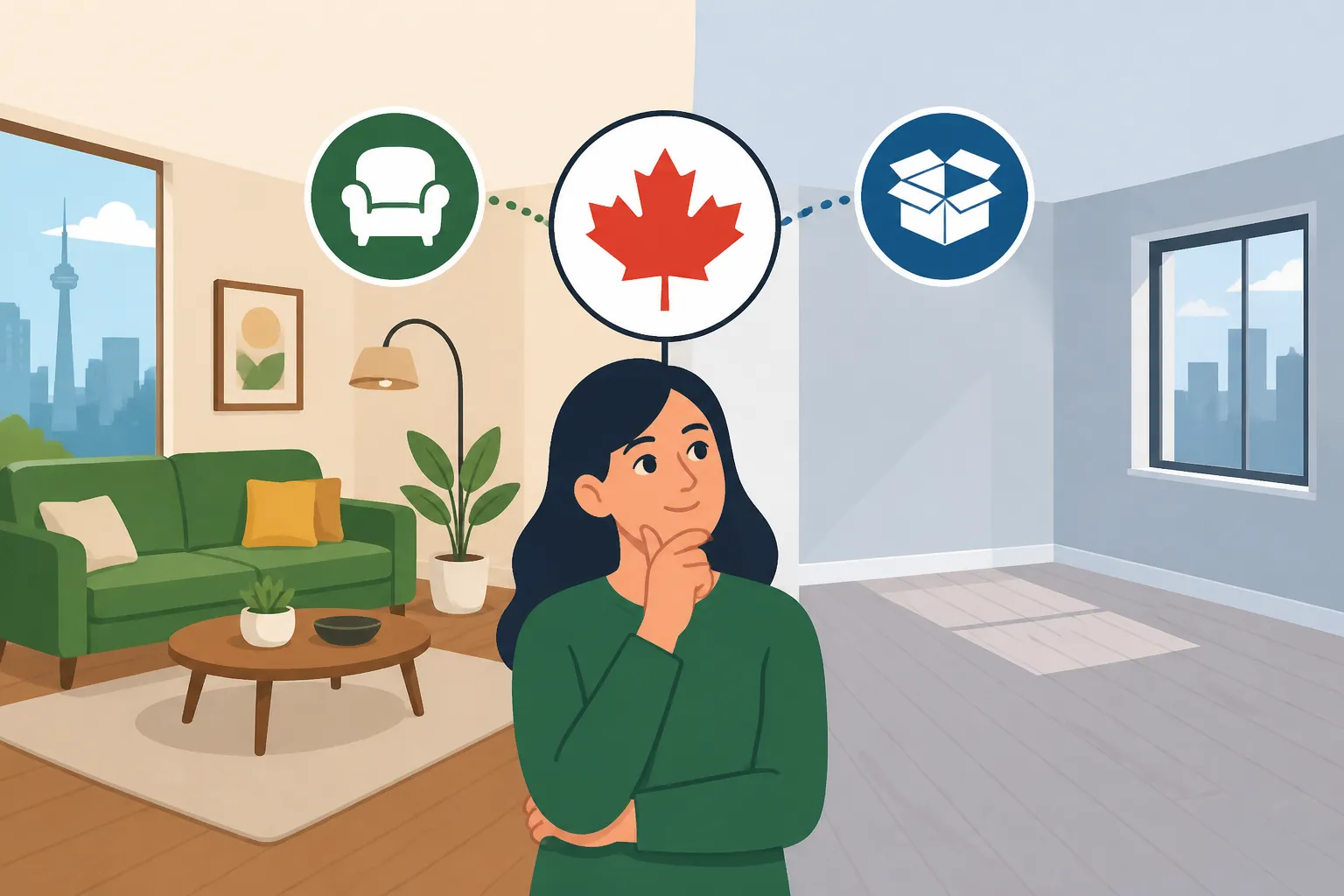
Understanding Furnished vs Unfurnished Rentals in Canada
One of the biggest head-scratchers when you first land in Canada, especially if you're like me and arrived with just a couple of suitcases, is figuring out where to live. The choice between a furnished or unfurnished rental can feel overwhelming, with each option having its own set of blessings and curses. This guide is here to walk you through the nitty-gritty of both, helping you make an informed decision that truly fits your lifestyle and budget in your new Canadian home.
What Exactly is a Furnished Rental in Canada?
When you hear "furnished rental" in Canada, it typically means a place that comes with the essential furniture and appliances you'd expect to find in a functioning home. Think beds, sofas, dining tables, chairs, and often, kitchenware like plates, cutlery, and cooking pots. Sometimes, it even includes linens and towels. It's designed for someone to move in with little more than their personal belongings.
Decoding "Furnished": What to Expect
The term "furnished" isn't always cut and dry across Canada, and what one landlord considers fully furnished, another might call partially furnished. Generally, you can expect major furniture pieces in the living room (sofa, coffee table, TV stand), bedroom (bed frame, mattress, dresser, nightstands), and dining area (table and chairs). Kitchens almost always include a refrigerator, stove, and sometimes a microwave or dishwasher. More often than not, you'll find basic kitchen tools and dishware, which is a huge relief when you're just starting out.
However, don't assume every little thing is included. I once rented a "fully furnished" condo in Vancouver that had everything but bath towels and a kettle! It's crucial to clarify with the landlord or property manager exactly what items are provided. Ask for an inventory list before signing anything. This list is super important, not just for your peace of mind but also for avoiding disputes about damages or missing items when you eventually move out. Remember, "furnished" often doesn't extend to electronics beyond a basic TV, nor does it typically include things like personal decor, cleaning supplies, or pantry staples.
The Immediate Convenience Factor
The undeniable charm of a furnished rental, especially for newcomers, is the sheer convenience. Imagine stepping off the plane, heading straight to your new apartment in, say, downtown Toronto, and not having to worry about where you'll sleep that night or how you'll cook your first Canadian meal. This immediate comfort is a massive stress-reducer. You bypass the hassle of furniture shopping, delivery schedules, and the initial setup that comes with an empty apartment.
For those on a temporary work assignment, international students, or anyone planning a shorter stay, this convenience translates directly into time and money saved. You don't have to invest in furniture you'll only use for a year or two, nor do you have to deal with selling it or shipping it when you leave. Many serviced apartments or corporate rentals, often found in major cities like Montreal or Calgary, are furnished to a high standard, sometimes even including utility costs and internet, making them incredibly appealing. It’s a bit like an extended-stay hotel, but with a more homey feel. This also means you can often focus on other urgent tasks, like sorting out your How to Apply for a Social Insurance Number (SIN) in Canada or How to Apply for Your Provincial Health Card in Canada (2027), without the added pressure of furnishing a home.
When a Furnished Place Makes Sense
A furnished rental truly shines in a few specific scenarios. If you're coming to Canada for a temporary period – perhaps a one-year contract, a study program, or a long vacation – it's often the most logical and cost-effective choice. It’s also excellent for individuals or couples without existing furniture, saving you thousands in upfront costs for purchasing new items. Similarly, if you're still exploring different cities or neighbourhoods within Canada and aren't ready to commit to a long-term location, a furnished spot offers flexibility.
Think of it this way: if you're not planning to stay in the same place for more than a couple of years, the higher monthly rent of a furnished unit often balances out against the expense and effort of buying, moving, and eventually selling furniture. It's also a great option if you’re trying to build your How to Build a Credit Score as a Newcomer in Canada and want to keep initial expenses manageable. Moreover, for digital nomads or those who value minimalist living, it simplifies life considerably. And hey, if you're arriving from overseas and just trying to get your feet wet, the thought of shipping all your worldly possessions or buying everything new can be daunting. Services like Airalo for eSIMs can help you get connected instantly upon arrival, keeping your initial setup focused on essentials rather than furniture.
The Allure and Pitfalls of Unfurnished Rentals in Canada
Stepping into an empty apartment can be both exciting and terrifying. An unfurnished rental, by definition, is just that: walls, floors, and basic fixtures. It's a blank slate, devoid of furniture, appliances beyond the usual fridge and stove, and personal touches. While it often boasts a lower monthly rent, it comes with a whole other set of responsibilities and costs.
The Blank Canvas Appeal
For many, myself included, the idea of an unfurnished apartment holds a distinct appeal. It's a true blank canvas, a space you can genuinely make your own. You get to choose every piece of furniture, every decor item, creating a home that reflects your personal style and comfort preferences. This level of personalization is simply not possible in a furnished unit, where you're often stuck with someone else's taste – which might not always align with yours!
This freedom extends beyond aesthetics. You control the quality and ergonomics of your furniture. If you spend hours working from home, investing in a good office chair and desk is paramount, something you might not find in a generic furnished setup. For families, an unfurnished space allows for child-friendly furniture, specific storage solutions, and a layout that best suits daily life. It feels more permanent, more "yours," which is a huge psychological benefit when you're establishing roots in a new country. Furthermore, an unfurnished rental often encourages a longer-term commitment, giving you a sense of stability and belonging.
The Hidden Costs and Efforts of Furnishing
Ah, the "hidden" costs. They're not truly hidden, but they can definitely sneak up on you if you're not prepared. An unfurnished rental might have a lower monthly sticker price, but the upfront investment required to make it livable is substantial. You'll need everything: a bed, mattress, sofa, dining set, possibly a desk, chairs, lamps, curtains, rugs, and all the kitchen essentials. Even if you shop at budget stores like IKEA or look for second-hand items, these expenses add up quickly.
Beyond the cost of the items themselves, there's the logistics. Transporting large items requires renting a U-Haul or hiring movers, which is another expense. Then comes the assembly – anyone who's put together IKEA furniture knows this isn't always a quick job. And what about utilities? With an unfurnished place, you’re almost certainly responsible for setting up your own How to Set Up Hydro (Electricity) in Your Canadian Home, Understanding Heating, Gas and Utility Bills in Canada, and How to Set Up Internet and Cable in Canada. These administrative tasks, while necessary, add to the initial mental load and financial outlay. Don't forget, if you're bringing furniture from overseas, you'll need to account for shipping costs, import duties, and the general headache of international logistics – though companies like Sirelo can certainly help streamline that process.
When an Unfurnished Place is the Best Bet
An unfurnished rental is almost always the go-to choice for those planning a long-term stay in Canada. If you envision yourself living in the same city or province for three years or more, investing in your own furniture makes financial sense. Over time, the cost savings on monthly rent will often outweigh the initial purchase price of furniture. Plus, you get to truly build a home that suits you perfectly, rather than adapting to someone else's choices.
This option is ideal for newcomers who are putting down roots, perhaps bringing their families, and want to create a permanent sanctuary. It's also great if you already own furniture and are making a permanent move to Canada, or if you're simply someone who values the freedom to design and curate their living space from scratch. While the initial legwork is considerable, the long-term comfort, personalization, and potential cost savings make it a highly desirable option for those committed to Canadian life. For a deeper dive into the rental process, check out The Complete Guide to Renting an Apartment in Canada (2027).
Cost Analysis: Furnished vs. Unfurnished – Beyond the Rent Price
Comparing the costs of furnished versus unfurnished rentals goes far beyond just looking at the monthly rent. There are numerous direct and indirect expenses that can significantly sway your decision. It's about looking at the big picture and calculating your total cost of living, not just the sticker price of the apartment.
The Monthly Rent Discrepancy
Let's talk about the most obvious difference: the rent. Generally, a furnished apartment will command a higher monthly rent than an unfurnished one in the same building or neighbourhood, often by several hundred dollars. This premium covers the cost of the furniture, its depreciation, maintenance, and the added convenience for the tenant. For instance, in a city like Toronto or Vancouver, a furnished one-bedroom apartment could easily be $300-$700 more per month than an unfurnished equivalent.
This difference adds up quickly over time. If you save $400 a month on an unfurnished apartment, that's $4,800 a year that you can put towards buying your own furniture, savings, or other expenses. However, this calculation only holds true if you have the capital to purchase furniture upfront or if you're staying long enough for the savings to materialize. For a short-term stay, say six months, that $2,400 extra you paid for a furnished place might still be less than the cost and hassle of buying, moving, and selling furniture for an unfurnished unit. It’s a classic short-term vs. long-term financial trade-off.
Upfront Costs and Long-Term Savings
This is where the financial planning really comes into play. With an unfurnished rental, your upfront costs will be significantly higher. Beyond the first and last month's rent (which is standard practice in many Canadian provinces, as detailed in How to Sign a Lease and Pay a Deposit in Canada), you're looking at spending thousands on furniture and household items. Even if you're resourceful and hunt for deals on Kijiji, Facebook Marketplace, or budget stores, a basic setup could easily run you $2,000 to $5,000. Add to that the cost of moving, utility setup fees, and connecting your internet, and you’re looking at a hefty initial outlay.
| Feature | Furnished Rental | Unfurnished Rental |
|---|---|---|
| Monthly Rent | Higher (often $300-$700+ more) | Lower |
| Upfront Costs | Lower (mostly just first/last month's rent) | Higher (furniture, moving, utility setup, first/last rent) |
| Furniture Expense | None (included in rent) | Significant initial investment |
| Moving Costs | Minimal (personal items only) | High (renting truck, hiring movers, international shipping) |
| Personalization | Limited | High (create your ideal home) |
| Flexibility | High (easier for shorter stays) | Lower (more effort to move out) |
| Lease Term | Often flexible (monthly, 6 months, 1 year) | Typically 1 year minimum |
| Utilities | Sometimes included (especially in short-term) | Usually separate and tenant's responsibility |
| Insurance | Contents insurance still recommended | Essential for all belongings |
On the flip side, once these upfront costs are absorbed, your monthly expenses for an unfurnished place will generally be lower. Over a period of two to three years, the cumulative savings on rent will likely surpass the initial investment in furniture. This leads to long-term financial advantages. Moreover, the furniture you buy becomes your asset, something you can take with you to your next home, sell to recoup some costs, or continue to use for many years. It's an investment in your personal comfort and financial independence. For a broader perspective on your overall expenses, consider reviewing The Complete Guide to Cost of Living in Canada for Newcomers (2026).
The Value of Time and Reduced Stress
Let's not underestimate the non-monetary costs. The time and mental energy spent on furnishing an apartment can be immense. From endless online browsing to visiting multiple furniture stores, coordinating deliveries, and assembling pieces – it's a project. For newcomers already grappling with immigration paperwork, job searches, and adapting to a new culture, adding "furnish an entire apartment" to the to-do list can push stress levels through the roof.
A furnished rental buys you back this invaluable time and peace of mind. You can focus on settling into your job, exploring your new city, or simply relaxing without the pressure of having an empty home. This is particularly valuable during those critical first few weeks and months in Canada, as outlined in The Complete Guide to Moving to Canada: Your First 90 Days (2027). The ability to hit the ground running, to have a comfortable bed waiting for you, and a kitchen ready for a meal, can significantly ease your transition and positively impact your early experiences. The cost difference might be worth it just for the sake of your sanity!
Logistics and Lifestyle: Making the Right Choice for Your Canadian Journey
Beyond the financial spreadsheet, your personal circumstances and desired lifestyle play a huge role in deciding between furnished and unfurnished rentals. What are your long-term goals in Canada? What kind of living environment do you thrive in? These are critical questions to ponder.
Short-Term vs. Long-Term Stay Considerations
This is probably the single most important factor. If you know for certain that your stay in Canada is temporary – perhaps for a specific work project lasting less than a year, a university exchange program, or even just exploring the country before committing – a furnished rental is almost always the smarter move. The ease of moving in and out, without the burden of furniture, offers unparalleled flexibility. You can arrive with just your luggage and leave the same way, minimizing logistical headaches.
For long-term residents or those planning to make Canada their permanent home, the unfurnished route is usually more beneficial. While the initial effort is greater, it paves the way for a truly personalized home and greater cost efficiency over several years. If you’re planning to stay in Canada for three, five, or ten years, buying your own furniture becomes a sound investment. It creates a sense of permanence and allows you to establish deeper roots.
Family Needs and Personalization
When you're single or a couple, adapting to a furnished space might be relatively easy. But if you're moving to Canada with a family, especially with young children, the equation changes dramatically. Furnished apartments, while convenient, rarely cater to specific family needs. You might find the beds too small, the sofa uncomfortable, or the lack of proper storage a constant frustration. Children often need specific types of furniture, like cribs, bunk beds, or play areas, which are rarely provided in standard furnished units.
An unfurnished rental gives you the power to design a home that is truly family-friendly. You can choose durable furniture, set up dedicated spaces for play and study, and ensure safety features are in place. This level of control over your living environment can significantly impact your family's comfort and well-being, allowing each member to settle in and thrive. It’s about creating a true home, not just a temporary dwelling.
Moving Day: Easing the Transition
Picture this: you've just arrived in Canada after a long flight, jet-lagged and a little disoriented. If you've opted for a furnished rental, your "move" mostly involves unpacking your suitcases and maybe a quick grocery run. You can settle in almost immediately. This smooth transition can make a world of difference in your initial experience and overall well-being.
Now, imagine the same scenario with an unfurnished place. You arrive to an empty shell. Your first few days (or even weeks) will be dominated by coordinating furniture deliveries, assembly, and setting up utilities. This can be exhausting and frustrating, especially if you're dealing with language barriers or unfamiliar systems. While this initial challenge eventually gives way to a personalized home, the moving-in process itself is a significant hurdle. If you're coming from another country, don't forget that services like Sirelo can assist with international moving logistics, which can be a lifesaver when bringing your life's possessions to an unfurnished Canadian home.
Lease Agreements, Deposits, and Tenant Rights: What You Need to Know
Navigating lease agreements in Canada can be a maze, and when you add the "furnished vs. unfurnished" element, there are even more details to pay attention to. Protecting yourself and understanding your obligations is paramount, regardless of what type of rental you choose.
Specifics of Furnished Rental Agreements
With a furnished rental, your lease agreement will typically include an inventory list of all the items provided by the landlord. This is a crucial document. Before you sign, go through every item on that list and check its condition. Note down any existing damages, scratches, or wear and tear, and ideally, take photos or videos as proof. This safeguards you from being charged for pre-existing damage when you move out. This point cannot be overstated: many newcomers get hit with unexpected bills because they didn't document the initial condition.
The lease might also specify rules regarding the use and maintenance of the furniture. For instance, some landlords might prohibit certain types of pets on furnished properties or have strict cleaning clauses. Pay attention to clauses about normal wear and tear versus tenant-caused damage. Damages that go beyond reasonable wear and tear will likely be deducted from your security deposit, which is why that initial inventory check is so vital. It's also common for furnished rentals to have shorter lease terms (e.g., 6 months or month-to-month), offering more flexibility but sometimes at a higher premium.
Understanding Your Rights and Responsibilities
Tenant rights in Canada vary by province, but some general principles apply. Regardless of whether your place is furnished or unfurnished, your landlord has a responsibility to maintain the property in a safe and livable condition. You, in turn, are responsible for keeping the property clean and not causing undue damage. For a comprehensive overview, refer to Understanding Tenant and Landlord Rights by Province in Canada.
For furnished units, your responsibility extends to the care of the landlord's property. If a sofa gets stained, or a kitchen chair breaks due to your negligence, you could be liable for repair or replacement costs. It’s always a good idea to discuss with your landlord upfront about how issues with furniture (e.g., a broken appliance, a wobbly chair leg) will be handled. Will they repair it? Will you be charged? Clarifying these points can prevent future disputes.
Dealing with Damage and Inventory
Disputes over damage are perhaps the most common headaches when moving out of a furnished rental. As I mentioned, an exhaustive inventory list, complete with photos or videos dated and agreed upon by both parties at the start of the tenancy, is your best defense. When you move out, perform a final walkthrough with the landlord, comparing the current condition against the initial inventory. Any new damage should be clearly documented and discussed.
If there's a disagreement, the landlord might try to deduct costs from your security deposit. In Canada, provinces have specific rules about security deposits and how they can be used. For example, in Ontario, landlords can only ask for the last month's rent deposit, and no separate "security deposit" for damages. However, if damage occurs, landlords can still seek compensation. Knowing your rights and having your documentation in order will be crucial if you need to escalate a dispute to your provincial Landlord and Tenant Board.
Practical Tips for Finding and Securing Your Ideal Rental
Finding a rental in Canada, especially in competitive markets like Vancouver, Toronto, or Montreal, can be tough. But with the right approach and clear understanding of your needs, you can secure a place that feels like home.
Where to Look: Online Platforms and Local Resources
The internet is your best friend when hunting for rentals in Canada. Popular online platforms include:
- Realtor.ca: Primarily for properties listed by real estate agents, often higher quality.
- Kijiji and Facebook Marketplace: Great for private listings, often including furnished units, and for buying second-hand furniture for unfurnished places. Be cautious and verify listings.
- Rentals.ca, PadMapper, Zumper: Aggregators that pull listings from various sources.
- Specific property management company websites: Many large buildings in major cities are managed by companies like Greenwin, CAPREIT, or Hollyburn. Check their direct sites.
- University housing boards: If you're a student, your university might have resources for both on-campus and off-campus housing, often including furnished options.
Local resources can also be invaluable. Word-of-mouth in expat communities, local community centre bulletin boards, or even driving around your desired neighbourhood looking for "For Rent" signs can yield results. For a more detailed guide on finding a place, read How to Find an Apartment to Rent in Vancouver.
Asking the Right Questions During Viewings
Whether it's furnished or unfurnished, a viewing is your chance to gather critical information. Don't be shy!
For ALL rentals:
- What are the lease terms? (e.g., 12 months, 6 months, month-to-month)
- What's included in the rent? (e.g., utilities, internet, parking, laundry)
- What is the process for maintenance requests?
- Are pets allowed? If so, are there any restrictions or additional fees?
- What is the policy on rent increases? (Crucial, as rent control varies by province – check out Understanding Rent Increases and Rent Control by Province in Canada)
- How is garbage and recycling handled?
- What is the neighbourhood like? (noise levels, amenities, public transport access)
Specifically for furnished rentals:
- Can I get a detailed inventory list of all items included? (Insist on this!)
- What is the condition of specific furniture items or appliances? (Point out any issues).
- Who is responsible for repairs or replacement of furniture if it breaks due to normal use?
- Are linens, towels, or kitchenware included?
- Is there an option to remove certain pieces of furniture if they're not needed? (Unlikely, but worth asking).
Insuring Your Belongings: Even in a Furnished Place
This is often overlooked but incredibly important. Even if you're renting a furnished apartment, your landlord's insurance policy will NOT cover your personal belongings. If there's a fire, theft, or flood, your clothes, electronics, passport, and other valuables would not be covered. This is where tenant insurance (also known as renter's insurance) comes in. It's usually quite affordable, often costing as little as $20-$40 per month, and provides coverage for your possessions, liability if someone is injured in your unit, and sometimes even temporary living expenses if your unit becomes uninhabitable.
For unfurnished rentals, tenant insurance is even more critical, as you’ll have a higher value of personal property to protect. Many landlords in Canada actually require tenants to have renter's insurance as part of the lease agreement. Don't skip this step – it's a small expense that offers huge peace of mind.
Disclaimer
The information provided in this guide is for general informational purposes only and does not constitute legal or professional advice. While we strive to keep the content up-to-date and accurate, regulations and market conditions in Canada, particularly concerning rentals, housing, and immigration, can change rapidly. Always consult with relevant professionals, such as a real estate agent, lawyer, or immigration consultant, for advice tailored to your specific situation.